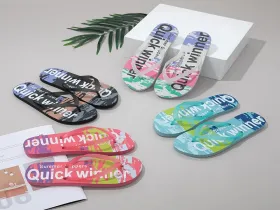
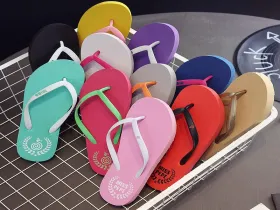
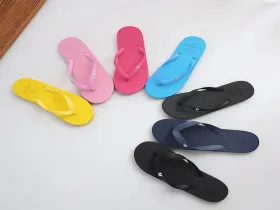
Repeating a promotional flip-flop program is supposed to be the easy part. The logo die already exists, the last shape has been approved, and the color is locked in your spec sheet. Yet buyers who reorder hollow cut logo flip flops without re-checking the retail pack label almost always discover a problem after the cartons have been sealed — usually in the form of a rejected shipment at a distribution centre or a reprint request from the retailer's compliance team. This article walks through the label items that actually need confirming between campaigns, and which of them depend on tooling you already own versus paperwork you may have to redo.
Why the second run is where label mistakes surface
The first order of a custom EVA promotional program is heavily documented: proofs are signed, samples are approved, and the packaging artwork is reviewed line by line. On a repeat campaign with the same logo tooling, buyers often assume nothing has changed. In practice three things move quietly between runs — the material formulation, the retailer's own label requirements, and the destination market's rules. Each of them can touch what you print on the pack.
A cutout logo does not change how a flip-flop is labelled, but it does affect how the item is described. When the brand mark is physically removed from the footbed rather than printed on it, the material statement on the label still has to match what was actually foamed and cut. That link between the label wording and the physical build is exactly where custom logo flip flops programs go wrong, because the tooling is identical while the foam recipe may not be.
Confirm the material declaration still matches the foam in the tooling
Colour on EVA foam is formed during one-step foaming with added colour masterbatch, so a repeat order can look identical to the approved sample while using a different masterbatch batch or a slightly different grade. If your label states a specific foam composition or a compliance claim, ask the factory to restate the material used for this run rather than assume it carries over from the last purchase order.
- The base formulation on the label — confirm whether the soles are EVA, EVA/rubber, or an EVA/PE build, and make sure the wording on the pack matches the actual sole stack rather than the marketing name used in your listing.
- The destination country standard — tell your supplier where the goods are landing. A Shenzhen custom EVA foam manufacturing partner can recommend raw materials that meet the corresponding national standards for that market, but only if you state the market on the repeat order instead of letting it default to last year's paperwork.
- Which certificate covers this order — ISO 9001:2015, CE, EN-71, FDA, FCC, RoHS, SGS and REACH are held at factory level. A label or a retailer's vendor form needs the specific test report for the product and market you are shipping to, not a generic list of certificates.
Practical rule: before releasing a repeat PO, request the current material data sheet and the applicable test report number for this production batch. If your label artwork quotes a standard or a composition, the report reference should be on file before the plates are made — not after.
Re-check size and fit statements against the tooling you are reusing
Retail pack labels usually carry a size range or a "one size fits" claim. That claim is tied to the cutting die, not to the logo die. If your repeat run uses the same logo tooling but a different sole length, width, or thickness — for example because you moved from an adult beach program to a kids' giveaway — the size block on the label has to be rewritten even though the brand mark is unchanged.
Ask for the measured dimensions of the current production sample and compare them with the figures printed on the previous pack. For one-size styles, confirm the foot length the sole is actually cut to fit, and state it in millimetres if your retailer requires a numeric claim. If you are also reusing an embossed or diamond-pattern footbed from an earlier run, verify that the tread finish has not been substituted, because some retailers require the finish to be described on the pack.
Age grading and safety wording do not carry over automatically
A hollow-out logo is a decorative cut, but a cut can create a small feature that changes how an item is graded for children. If your repeat campaign puts the same flip-flop into a kids' assortment or a family gift pack, re-confirm the minimum age statement, any choking-hazard wording, and whether the retailer requires a children's product safety test on file for this run. Fulikai runs sixteen types of tests during production, including colour fastness, tensile strength, ink environmental testing and children-product safety testing, so you can request the relevant report for the batch instead of relying on an older one.
The same applies to care instructions. EVA flip-flops are usually labelled with a wash temperature and a drying instruction, and some buyers add a note about avoiding prolonged high-temperature exposure because heat can age or deform the foam. If the previous pack carried that wording, confirm it is still printed on this run; if the retailer has updated their care-label template, send them the current one before plate-making starts.
Packaging format and unit labelling
Retail pack labels are inseparable from the pack itself. Pairing, bag type, and carton count all change what has to be printed, and a repeat order is where these details drift.
| Label item | What to confirm on a repeat run |
|---|
| Unit configuration | Pairs per bag or per pack, and whether the retail unit is single-pair or multi-pack. Customer-specified packaging is available, so state the configuration again rather than assuming the previous one. |
| Barcode position | Where the retailer wants the code placed on the new artwork, and who supplies the file. A reused logo die does not mean a reused barcode layout. |
| Country-of-origin marking | The wording and its location on the pack or the product, confirmed for the current destination market. |
| Care and safety block | Wash temperature, drying method, heat warning, and age grading — re-verified against this batch's test reports. |
| Colour and colour name | The printed colour name on the pack versus the masterbatch used in the foam. Names that matched last season may not match a new batch. |
Print method affects how much of the label you can reprint cheaply
If the logo itself is unchanged but the surrounding print needs an update, ask which process is being used. Heat-transfer printing on EVA gives clean coverage with no underlying base colour showing through, and multi-pass white-base printing raises saturation — useful when a retailer asks for a brighter brand colour on the same tooling. Plate-making turnaround is short enough that a label-driven artwork change can still be absorbed in the schedule, but only if you raise it before the run is booked.
Where the logo is hollow-cut rather than printed, the cut die and the print plate are separate costs. Confirm which one your change actually touches. A wording or care-block update on the pack may need no tooling change at all, while a revised brand mark does — and knowing that before you issue the PO keeps the repeat order in the fast lane instead of restarting approvals.
A short pre-production checklist for the repeat PO
- Current material data sheet and applicable test report number for this batch, matched to the label wording.
- Destination country restated in writing, with the standard your pack claims must meet it.
- Measured sole dimensions versus the size claim printed on the previous pack.
- Age grading and safety wording re-confirmed for the new assortment or channel.
- Pack configuration, barcode placement and origin marking signed off by the retailer's compliance contact.
- Written confirmation of which tooling is reused and which plate, if any, must be remade.
Buyers who send this list with the repeat PO instead of after the first carton sample usually keep the original delivery window intact. Fulikai's custom process runs through requirements consultation, proposal and quotation, design drafts and renderings, mould opening and print moulding, signature confirmation, and a 30% deposit on signing — so the label review belongs at the consultation step, where changes are still free.
If you are reordering cutout-logo flip-flops and want the pack label verified against this batch's material and test documentation before plate-making, send your previous artwork and the destination market to our team.
Send your requirements or call +86 13827489472.