The artwork is finished. The question you now face is not whether a factory can cut foam — it is how many days each step takes, what must be approved before tooling starts, and which decisions are still open when your drawings leave the building. A handoff schedule settles those points in advance, so a design that exists only on paper reaches a signed pre-production sample without three surprise delays along the way.
Below is the sequence we work to at Fulikai, an EVA foam products manufacturer in Shenzhen, together with what your team should have ready at each stage. The working windows quoted here are the ones our own service pages publish.
Stage 1 — Consultation: what the factory needs before it can commit to a date
The first conversation decides whether the rest of the schedule holds. Send the drawing in a vector format with dimensions marked, and state the four variables that move price and lead time more than anything else: part thickness, durometer, print method, and destination country. Thickness and hardness decide whether an existing foam slab will do or a new mould is needed. Print method decides whether plate-making enters the critical path at all.
Tell the factory where the goods are going. Raw material recommendations depend on the importing country's requirements, so this belongs in stage 1 rather than at the end of production. Our team recommends materials that meet the relevant national standards once we know the destination — see EVA foam color matching and raw materials.
Ask for a design review at this point, not after the sample arrives. A manufacturer working from your drawings can flag problems in linework, corner radii and thin sections before anything is cut. We review submitted designs and return improvement suggestions on details such as linework under our custom EVA foam cutting and stamping service.
Stage 2 — Proposal, quotation and the two numbers that set your calendar
A usable quotation separates three costs that buyers often see bundled: tooling or plate cost, sample cost, and unit price at your target quantity. It also states the sampling window and the production lead time as separate lines. If those two are merged into one figure, you cannot plan a launch date.
On our side, printed designs need plates. Plate-making takes 5–7 days, and sample plates cost a few hundred dollars. Sample development itself runs 5–7 working days from an approved artwork file. Those two windows overlap only if the plate order starts while the cutting layout is being prepared, so ask in writing which day the plate work begins — otherwise the two 5–7 day periods simply add up.
Stage 3 — Drafts and renderings: the approval nobody should skip
Before tooling, request a rendered draft showing the print in position on the part. This is where colour placement, logo scale and registration get settled on paper instead of on foam. It costs nothing extra and removes the most common cause of a second sample round.
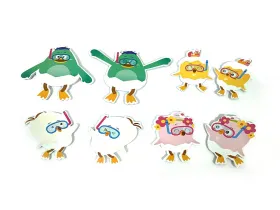
A US brand brought us a foldable bath puzzle that its previous supplier had refused: screen printing on one side, heat-transfer printing on the other, double-sided lamination for precise fitting, plus foldable packaging. Our R&D team read the drawings, committed to sampling within one week, and delivered the sample three days early — which is why the buyer's CEO flew to Shenzhen the day the parcel arrived. The
Skip Hop case shows how much a clean drawing package shortens development.
Stage 4 — Tooling and print moulding: where the schedule is won or lost
Ask for the cutting tool status and the plate ready date as two separate lines, because in most jobs they are produced on different tracks: shapes come from stamping dies and laser cutting, while the print plate is made by a platemaker. If one of them slips alone, you can see it immediately instead of discovering it when nothing arrives.
Print quality follows from the plate more than from the foam, so judge a supplier's sample by edge definition and colour coverage rather than by how soft the piece feels. Our heat-transfer printing is applied without an underlying base colour showing through, with multi-pass white-base printing for saturation — details are on the heat transfer printing on EVA foam page. If your design needs partial heat transfer combined with screen printing and stitching, treat it as a process-development task rather than a standard run; the Monster Jam cheering hands case began from conceptual ideas only, and the client used our sample as the quality benchmark while comparing factories for months.
Stage 5 — Sample sign-off: write down what you are approving
Confirmation of signature closes the development phase. Sign off against a checklist you prepared at stage 1, not against how the sample feels in your hand: dimensions and thickness tolerance, colour match under both daylight and shop lighting, print registration, adhesion after flexing, edge trim quality, and the packing method you specified. Keep one approved physical sample at your office as the reference for incoming inspection; without it, "matches the sample" has no fixed meaning.
Any change you make after sign-off restarts plate-making or tooling, so batch your revisions into a single round and ask the factory to confirm which changes affect the schedule before they are applied.
Stage 6 — Deposit, production window and inspection
Contract signing is followed by a 30% deposit; on our standard terms the remaining 70% falls due after pre-shipment inspection passes. Production then runs 25–30 working days from sample confirmation, adjusted for actual order conditions. Our delivery page separately states that bulk orders can be delivered within 15 days, and adds that for urgent orders an in-house factory can reallocate resources to protect the ship date — worth asking about directly if your launch window is fixed.
Book the third-party inspection at contract signing rather than when goods are finished, so the inspector's visit is inside the schedule instead of appended to it. Our products pass 16 types of test during production — colour fastness, tensile strength, ink environmental testing and children's product safety testing among them — followed by full manual inspection before shipment, and third-party inspection is supported; see EVA foam factory audits and inspections.
A working handoff schedule in one table
| Stage | Your team delivers | Factory returns | Working window |
|---|
| Consultation | Vector drawing with dimensions, thickness, durometer, print method, destination country | Design review notes on linework and feasibility; material recommendation for the destination market | Days 1–3 |
| Proposal and quotation | Target quantity, packing request, delivery port or address | Tooling/plate cost, sample cost, unit price, sampling window and production lead time as separate lines | Days 3–5 |
| Drafts and renderings | Written approval of artwork placement and colour codes | Rendered draft with print in position | Days 5–7 |
| Tooling and print moulding | Final approved artwork file | Cutting die / stamping tool status, print plate ready date as separate lines | Plate-making 5–7 days; ask which day the plate order starts |
| Sample development | Packing specification and labelling request | Pre-production sample plus the test points you will sign off against | 5–7 working days, counted from artwork approval and plate completion |
| Sign-off and deposit | Signed confirmation sheet, retained reference sample, 30% deposit | Production plan with inspection date fixed inside the window | Contract day; balance after inspection passes |
| Production and delivery | Inspection booking, shipping instructions | Finished goods after full manual inspection; tracking through a dedicated contact | 25–30 working days from sample confirmation; bulk orders quoted within 15 days |
The day counts above assume one approval round per stage. Build one extra week into your launch calendar for a second sample round if the design combines partial heat transfer, lamination and folding structures — that is exactly where technical disputes appear.
What to put in writing before you release drawings
- Which stage starts the clock for each quoted window, since "5–7 working days" means nothing without a named trigger date.
- Who owns the tooling and print plates after payment, and how quickly they can be reused on a reorder.
- The change-control rule: which revisions restart plate-making, and which are free.
- The inspection standard you will apply, with the approved sample as the reference object.
- Whether the material grade recommended for your destination country is fixed in the contract text.
Ready to move from drawings to a signed sample
Send us your drawings and get a stage-by-stage plan
Fulikai has been making custom EVA foam products in Shenzhen since 2008, exporting to Japan, South Korea, Europe and the United States. Browse existing work in our custom EVA foam product samples gallery, follow the full custom EVA product order process, or send your requirements through our message form. Sales hotline: +86 13827489472.