Short answer: yes, but the number you get early is a working figure, not a locked one. A Shenzhen EVA foam products manufacturer can quote floating alphabet sets while you are still deciding which characters, colours and pack counts to carry, as long as the handful of variables that actually move cost are settled first. Below is what has to be fixed before pricing, what can stay open, and how to use an early quote to compare suppliers without ending up holding inventory nobody reorders.
What a factory needs before it can price a bath letter set
Foam alphabet sets are made from sheet EVA that is cut, printed and packed, so the cost drivers are material, tooling and packing rather than complicated electronics. Before any responsible custom EVA foam manufacturing partner commits a unit price, these four inputs need to be defined:
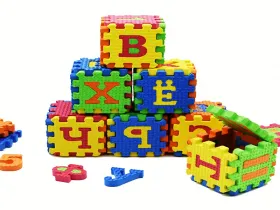
- Piece count and character mix. A set can be 26 letters only, 36 pieces with numbers 0-9 added, or a larger mixed set that includes animals and vehicles. Our EVA alphabet set is built as 56 pieces: 26 uppercase letters, 10 digits, 8 sea-animal shapes and 6 transport shapes.
- Piece size and thickness. Bath letters on our catalogue sit around 2.5 to 3 inches per character. Thickness changes both the foam weight per set and how well a wet piece sticks to a tub wall.
- Colour plan. Random assorted colours are cheaper than an assigned colour per letter, because sorting by hand adds labour at packing.
- Packaging format. Mesh storage bags with suction cups, colour boxes for retail shelves and plain bulk bags each carry different material and filling costs.
Everything else — which specific letters you launch first, how many SKUs you split the order into, whether you reorder the vowels before the consonants — can stay open during quotation. That is why a supplier who asks about size, mix and packaging in the first reply is usually more reliable than one who quotes immediately.
How to get a factory price that stays valid
Ask for a tiered quotation instead of a single number. A tiered quote from an EVA educational toy manufacturer normally separates four lines, and each line behaves differently when your inventory plan changes:
- Unit price by quantity band. Prices move at the bands where material usage and machine setup are amortised differently. Confirm which band applies to your trial order and which applies once the item is reordering well.
- Tooling and cutting die cost. A new character shape needs a die or laser setup. Existing shapes from the supplier's sample library avoid this line entirely.
- Printing and plate cost. Custom printed designs, boxed branding and multilingual characters add plate work. Our heat-transfer printing uses multi-pass white-base printing so colours stay saturated on coloured foam, and plate-making is quoted separately from unit price.
- Packing and carton specification. Retail-ready packaging is priced as a component, not absorbed invisibly into the piece price.
On timing, our published workflow runs from needs consultation to proposal and quotation first, then design drafts and renderings, mould opening and printing moulding, signature confirmation, and a 30 percent deposit when the contract is signed. Plate-making takes 5 to 7 days and bulk orders can be delivered within 15 days, so an early quote does not lock you into a long lead time while you test which characters sell.
Where buyers lose money on alphabet inventory
The mistake that costs the most is treating every character as equal demand. Sets sell well, but households replace individual pieces, and the characters that go missing are not evenly spread across the alphabet. Two practical ways to handle this while your assortment plan is still open:
- Order by set for the launch, then reorder loose runs. A factory that cuts from the same sheet batch can produce replacement character runs later at a lower setup cost, as long as the foam colour and thickness stay the same. Fix the material formula early even if the character mix stays flexible.
- Keep the colour formula in one-step foaming. Colour added during foaming with masterbatch holds across production batches far better than surface colouring, so a reorder six months later matches the original shelf set. Tell the supplier your destination country early and they can match raw materials to that market's requirements.
- Do not commit to multilingual variants too soon. Cyrillic and Latin alphabet mats are separate tooling programmes. Test one language, then extend.
A practical sequence for undecided buyers
- Send the supplier a target size range, total piece count and packaging style, and state clearly that the character mix is not final.
- Request a tiered quote with tooling, plate and packing costs shown separately, so you can see what changes if you drop or add characters later.
- Ask for samples from existing shapes before paying for new dies. Our sample centre lists current alphabet and number designs you can evaluate as-is.
- Confirm the safety documentation your market requires for a children's bath item before signing. Our Custom Capabilities page lists CE, EN-71, FDA, FCC, RoHS, SGS and REACH among the certifications on file, but which certificate or test report applies depends on the specific product and destination market, so request it in writing for your own order.
- Lock the foam colour formula and material batch standard, then keep the assortment decision open until your first sell-through data arrives.
If you want a working quotation on a floating alphabet set, send the size range, piece count and packaging format to our team and we will return tiered pricing with tooling and plate costs itemised. Contact us or call +86 13827489472.