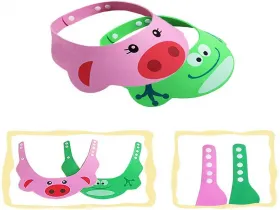
A pool store that orders kids' summer gear in April rarely has the appetite to pull an item in July. The shelf is set, the display is paid for and the unit already arrived. That is exactly why a low-selling variant of an adjustable EVA shampoo visor tends to drift along until the season closes, quietly tying up cash in a carton nobody wants. The decision is not emotional and it is not a single date on the calendar. It is a set of trigger points you can read off your own sell-through data, plus a short list of exit routes that cost far less than carrying dead stock into another January.
Start with sell-through against the season you actually have left
Pull one number first: units sold in the last four weeks divided by units on hand. For a seasonal kids' accessory inside a summer window, that ratio tells you whether the remaining weeks of warm weather can absorb the balance at the current price. Work backwards from your local climate and school calendar to the last week the item realistically sells — for pool-side goods that is usually when daytime water play stops, not when the store's season officially ends.
Then read the ratio plainly:
- The remaining weeks can clear the stock at full price. Keep the variant. Re-merchandise it instead of discounting — move it next to the bath and swim accessories that already have traffic, and let the shelf do the work.
- The stock clears only with a markdown. Decide the exit price now rather than in the final week, when you will be negotiating against yourself.
- Even a clearance price leaves leftovers after the season closes. This is the variant to phase out. Every extra carton you receive makes the exit worse, and it also blocks the open-to-buy you need for next season's winner.
Compare variants before you compare categories. If one colourway or character print of the visor moves while another stalls, that is a range problem with a simple fix: cut the stalled SKU and deepen the one that works. If every variant of the visor underperforms while kickboards and bath toys keep selling, the item itself is the problem, not the assortment around it.
The trigger points that say "phase out now"
Any one of these on its own is a reason to stop reordering. Two or more together mean you should be working an exit plan, not waiting for the season report.
- Weeks of cover past the selling window. On-hand stock plus units already in transit will not sell out before water play ends in your market.
- Markdown dependency. The variant only moves when discounted, so full-price margin is gone and clearance margin is thin.
- Assortment overlap. A similar visor or bathing cap from another brand sits on the same shelf, splitting demand across near-identical SKUs.
- Review or return friction. Repeated comments about fit — a visor that slips off a small head or gaps on a larger one — suppress repeat purchase and quietly raise your returns.
- No story left to sell. When the print, colour or packaging no longer matches what your kids' summer display looks like, the item stops earning its facings even if the product is fine.
For a visor specifically, fit complaints deserve extra weight. The Baby Shower Bathing Cap Fulikai supplies uses a four-gear buckle sized for roughly 40–55 cm head circumference and children aged 0–6. If your store's buyers are mostly parents of older or smaller children, the size band itself may be the reason the variant stalls — which is a specification problem to fix with the factory, not a demand problem to accept.
Decide whether the item failed or only the variant did
Before you write off the whole product line, separate three causes. They lead to very different actions.
| What actually failed | How it shows up in your data | Action |
|---|
| One print or colour | Other variants of the same visor sell at full price | Cut the SKU, keep the line, reorder the winning artwork |
| Specification or fit | Sell-through is weak everywhere and returns mention sizing | Change the spec with your supplier and retest on a small order |
| The product itself in this store | Every variant underperforms while neighbouring swim toys sell | Phase out, exit the balance, redeploy the space |
This distinction matters because a phase-out decision that skips it usually repeats next year: the buyer drops the item, then re-buys an identical spec from a different supplier and gets the same result.
Exit routes that cost less than carrying stock over
Once you commit to a phase-out, move the balance while demand still exists. In rough order of how much margin they preserve:
- Reposition inside the store. The visor doubles as a haircut shield and an outdoor sun shade. A second display near hair-accessory or travel fixtures can lift movement without touching price, and it is free.
- Bondle with a moving item. Pairing one visor with a sell-through winner — a swim kickboard, for example — converts dead stock into a promotion instead of a markdown, and lifts the basket.
- Single-price clearance, early. One honest price step two or three weeks before the season closes beats a cascade of deepening discounts in the last days.
- Baby-shower and gift channels. A visor that does not work as pool-side impulse stock often works better as a new-parent gift item through a carded display or a local gift partner.
- Hold nothing into winter. For seasonal kids' goods, storage plus re-labelling plus a fresh season's trend risk usually costs more than the clearance loss. Take the write-down and free the open-to-buy.
Timing the reorder cut-off so you exit clean
The most expensive phase-out mistake is ordering one more case after the decision. Set the cut-off backwards from your supplier's lead time: the last order you place must arrive with enough selling weeks left to clear it at full price, and nothing arrives after that. For custom EVA items made to your own artwork, the calendar is longer than for stock SKUs — Fulikai describes plate-making in 5–7 days and bulk delivery within 15 days on its custom manufacturing service, before ocean transit. So the practical rule: once your sell-through says phase out, stop all custom production that has not yet started, and finish only what is already in transit.
Write the cut-off date into the buy plan for the next season now, while the reasoning is fresh. Buyers who leave it to the next buying round re-order the same variant on the strength of a good end-of-season clearance — clearance velocity is not full-price velocity.
If you retest: change the thing that actually caused the stall
A phase-out and a relaunch are often the same decision with better inputs. Before re-testing a visor in the kids' summer range, fix one of three variables:
- Fit range. Confirm the adjustment mechanism and head-size band against the age group your store actually serves, rather than accepting a generic sizing claim.
- Print and colourway. Choose artwork that reads at shelf distance from across a pool deck. Heat-transfer printing on EVA is where detail and colour saturation either survive the distance or do not, so ask for a printed sample plate before committing to volume.
- Packaging and price point. A bagged item with no header card competes poorly as an impulse buy at a pool-side fixture. Carded packaging plus a clean single price usually does more for movement than another cent off the landed cost.
Keep the test small and time-boxed: one fixture, four to six weeks, one measurement of full-price sell-through. If it clears at full price, deepen; if it needs a discount, cut it and move on to the next candidate in your kids' bath and swim range.
The short answer
Phase out a low-selling adjustable EVA shampoo visor variant as soon as your four-week sell-through can no longer clear on-hand plus in-transit stock before water play ends in your market — or as soon as the unit only moves on markdown. Stop reordering at that point, work the balance through repositioning, bundling and one early clearance price, and hold nothing over. Then decide deliberately whether you are dropping the product line or just its specification, and put the reorder cut-off date in next season's buy plan so the same variant does not come back by accident.
For sizing bands, printed sample plates and small retest quantities on kids' bath and swim items, talk to Fulikai, a Shenzhen EVA foam products manufacturer — contact us.