Whoever paid for the artwork owns the characters in a beach-themed bath toy line — usually the brand, retailer or licensor placing the order, not the factory pressing the pieces. What your Shenzhen supplier owns is the process: the cutting dies, the print plates and the know-how needed to reproduce somebody else's crabs, starfish and seahorses in floating EVA foam, at wholesale volume, without damaging them on the way through a bathtub.
That distinction decides who can reorder next season, who can move production to another factory, and who answers to a licensor when a character appears on the wrong hangtag. Below is how ownership actually works on a bath toy release, and what to hand your manufacturer so the characters survive production.
Who holds the artwork, and who holds the tooling
Three separate things get called "the design" in a sourcing conversation, and each one has a different owner:
- The character IP. The named, drawn characters — a snorkelling chick, a cartoon crab, a seahorse with a personality. If an illustrator drew them for you under a work-for-hire agreement, or if you licensed them from an existing property, they are yours (or your licensor's). No foam factory owns this.
- The print artwork. The flattened, colour-separated file that actually goes onto the heat-transfer paper. Often the brand supplies it; often the factory's prepress team rebuilds it from a PDF or a physical sample. Whoever paid for that rebuild and holds the source file controls future reprints.
- The cut die. The steel rule shape that stamps the crab silhouette out of a foam sheet. A tooling charge usually sits on the quotation as a separate line, and that line is what determines whether the die is yours or the factory's.
A useful working rule: if you paid for it separately and asked for it in writing, treat it as yours. If it was bundled into "free with the order", assume the factory keeps it and may reuse it for another customer. Ask before the first purchase order, not after.
Three ways a bath toy character set arrives at a Chinese factory
1. You bring licensed or in-house characters
You send final artwork plus licence documentation, and the manufacturer reproduces it exactly. This is the cleanest path, and also the one overseas buyers most often underestimate: character licences usually come with style-guide rules on colour tolerance and minimum detail, and a foam print that misses those tolerances is a breach, not a cosmetic issue. Tell your supplier which colours are fixed before plate-making starts.
2. You bring a rough concept and the factory develops it
You send drawings or samples, and the service team at Fulikai's custom manufacturing page reviews them and comes back with improvement suggestions — line weight, how a thin fin will stamp out of foam, whether a face will still read after heat transfer. This is the most common arrangement for cross-border sellers and gift companies. Because the factory contributes engineering here, agree up front who owns the resulting production artwork.
3. You pick an existing sample and change only the palette
The fastest route, and the one with the weakest exclusivity. An off-the-shelf sea-animal set in a sample centre is not exclusive to you; your competitors can order the same shapes in different colours. If differentiation matters, change the character line art, not just the Pantone.
What "character" costs you in production terms
On a floating bath toy, the character is mostly a printing problem. A flat foam cut-out floats and dries easily; what makes it look like a designed sea creature rather than a shape from a craft store is full-colour heat transfer, plus polished edges. Here is where ownership questions turn into concrete supplier questions:
| Element | What to ask the factory | Why it matters for your characters |
|---|
| Print method | Is heat-transfer printing done in-house, and can a white base be laid down before colour? | EVA is often grey or off-white underneath. Without a white base, pastel sea creatures come out muddy and the printed colours shift between batches. |
| Plate-making | What does a sample plate cost, and how long does it take? Who keeps the plates after the run? | Plates are the physical record of your character artwork. If you reorder elsewhere and have no plates, you are paying to rebuild them. |
| Cutting | Stamping die or laser cutting for this number of shapes? | Laser suits small runs and complex outlines; a stamped die is faster at volume but is a tool you should own if the shapes are yours. |
| Colour control | Is colour added during foaming with masterbatch, so body colour matches the print? | One-step foaming with colour masterbatch keeps the foam's own colour stable, which matters when a character is half-printed and half-foam. |
| Edges | Are edges polished, with no sharp corners? | Toddler products get squeezed, chewed and dropped. Unpolished edges are a frequent cause of comments in toy safety review. |
A worked example: what a sea-animal assortment contains
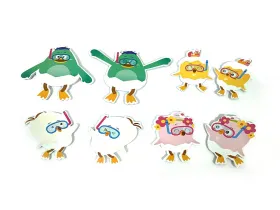
Take a published sample from our Sample Center: an EVA floating bath toy set built around snorkelling chicks, a crab, a starfish, a seahorse and fish. Those characters are printed on buoyant foam that floats and dries quickly, with polished edges and no sharp corners. Care is a rinse with water and an air dry — which is exactly why the print has to survive repeated wetting without lifting.
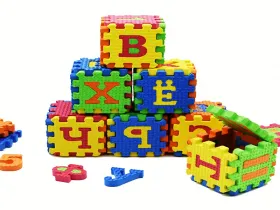
A second published sample shows the other end of the assortment question: a 66-piece foam bath toy set that mixes thirty sea-animal shapes — turtle, shark, dolphin, whale, starfish, lobster and others — with twenty-six A–Z letters and ten digits, packed with a fishing net for collection. That is an SKU decision as much as a character decision: one family of animal shapes plus standard alphabet tooling gives you a set that reads as educational rather than purely decorative, which changes who buys it and where it can be merchandised.
Beach scene beyond the tub
Buyers building a beach-themed programme rarely stop at bath pieces. The same EVA capability carries into water-side play and leisure goods — floating game trays and waterproof sets in the water sports goods range, for instance — so one supplier can cover a summer assortment instead of three.
The ownership answer in plain terms: the characters are yours if you supplied or commissioned them; the shapes, plates and dies belong to whoever paid for the tooling. Get that settled on the quotation before the first order, because reordering is where it bites.
Safety paperwork follows the character set, not the foam
Printed characters introduce inks, and inks are what testing looks at on a toddler bath toy. Our factory reports sixteen types of tests across production — colour fastness, tensile strength, environmental testing of ink materials and children's product safety testing among them — with full manual inspection before shipment and support for third-party inspection. Buyers planning a beach-themed release into the US, Europe or Japan should send the destination country with the enquiry; that is what determines which raw material we recommend and which test report applies to your set.
For a first custom run, the published workflow runs through needs consultation, a proposal and quotation, design drafts and renderings, mould opening and print moulding, signature confirmation, then a 30% deposit on signing. Plate-making is quoted at 5–7 days and bulk delivery within 15 days, so a character revision costs you about a week — not a quarter.
Five questions to put in your first RFQ
- Are the character files mine or yours after the first production run, and can you send the plates and dies on request?
- Which ink system do you print with, and which children's product test report covers it for my destination market?
- Can you match a Pantone in both the foam body colour and the print, and show me a signed-off pre-production sample?
- What is the minimum order for a fully custom character set versus an existing shape recoloured to my palette?
- If I reorder in twelve months, what has to be rebuilt, and what still exists in your tooling store?
Frequently asked questions
Can a factory sell my character set to another customer?
Only if you never established it in writing. Custom work is normally treated as confidential, but the practical protection is tooling ownership plus a stated exclusivity term on the purchase order. Settle that before paying any tooling charge.
Do licensed characters change how the product is made?
They change what can be changed. A licence style guide fixes colours and minimum detail, so colour tolerance and print registration become contractual points rather than preferences. Send those constraints with the artwork, not after the first sample.
What is the difference between a bath toy character and a bath puzzle character?
A puzzle piece has to interlock or stick, so its outline is fixed by function and only the surface is yours to design. A decorative floating cut-out has no such constraint, which is why sea-animal assortments are usually judged on print quality while puzzles are judged on fit.
How many characters should a beach-themed release launch with?
Match the count to your tooling budget. Every distinct silhouette is a separate cut; every distinct face needs its own plate area. Assortments that mix animals with letters and numbers give more shelf presence per die, because one alphabet tooling set serves several SKUs.
Next step
If you are preparing a beach-themed bath toy release and need a wholesale EVA bath toy manufacturer to quote your character set, send the artwork or a physical sample together with the destination country. Fulikai is a Shenzhen EVA foam products manufacturer working from customer drawings and samples, and reviews designs before tooling so a character that will not stamp cleanly gets flagged on paper rather than in foam.