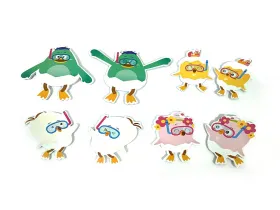
A pallet of bulk EVA toe separators arrives, the retail packs get filled, and then the first complaints come in: separators are splitting where the toes slip in. Nobody on either side of the order owns the fix, because nobody agreed in advance who would. That gap — not the foam — is what costs money.
If you buy nail consumables for a retail channel and sell them in small packs, this article is written for you. Below we set out who signs off on each step of a corrective action, what evidence to demand from your factory, and how the same clauses stop the argument before it starts.
Start with the part, not the blame
A toe separator is a small die-cut pad. On our line it is soft EVA foam, custom colours, printed by silk screen or heat transfer, and sold as a foot-care tool for nail-polish application and as a toe-separating pad for pedicures and manicures. Two features of that design decide how the part behaves under stress:
- The cutout is a stress concentration. The opening where the toes enter is die-cut or laser-cut, so its edge carries whatever force the user applies when pushing the foot in. A nick at that edge becomes the starting point of a tear.
- The material is expected to stretch and recover. Our published product description for this part calls it soft, comfortable and flexible with good cushioning, and notes that it can be washed and disinfected on both sides. A pad that is repeatedly stretched and wiped down is being tested in exactly the way a complaint report describes.
So when a tear appears around a toe cutout, the question is never whether EVA “can” fail there. It can. The question is which control slipped: the foam grade, the cutting tool, the wall thickness at the cutout, or how the pack was filled and handled after delivery.
Three roles, three non-transferable duties
On a small retail pack — a multi-piece inner pack you refill and ship to your own customers — accountability splits cleanly across three seats. Write them down before the purchase order, not after the complaint.
| Seat |
Owns |
Cannot delegate |
| Retail buyer / category manager (your side) |
The written specification: size, colour, print, inner-pack count, and the acceptance rule for the pack as sold. |
Approving a replacement lot without re-running the same check that caught the first one. |
| Factory quality lead (Fulikai side) |
The incoming-material record, the cutting-tool condition, and the pre-shipment inspection result for the lot in question. |
Answering a complaint with a general capability claim instead of that lot’s records. |
| Packaging and fulfilment owner (usually your side) |
How the separators sit in the inner pack, whether they are compressed or folded, and what happens to cartons in transit and on shelf. |
Attributing a cutout tear to the foam while packs are being over-packed or dropped. |
The most common failure we see in this category is not a bad batch. It is a complaint that arrives with no named owner for the acceptance rule, so each party assumes someone else tested it.
What the factory owes you as evidence
A supplier who can close a corrective action will produce lot records. Ours are structured around testing that already happens during production: our Shenzhen factory states that all products pass through 16 types of test in production, and tensile strength is one of the named items alongside colour fastness, ink environmental testing and children’s product safety testing.
For a tear complaint on a cutout part, ask for three specific things:
- The tensile result for the lot. Our factory reports full manual inspection before shipment and supports 100% third-party inspection, so a lot-level record should exist rather than a generic statement about quality.
- The cutting route used for your part. We produce shapes from customer drawings or samples by stamping and laser cutting. A worn stamping die and a fresh one can leave the same drawing with different edge quality at a small radius, so record which route was used and when the tooling was last serviced.
- The material recommendation tied to your market. We work with long-term upstream suppliers for foam materials and recommend raw materials that meet the standards of the destination country. Tell us the market you are shipping into, and ask which grade was quoted for it — then keep that answer in the file.
One practical note on numbers: our site publishes both a general capability claim about tensile testing and a rejection rate at pre-shipment inspection. Neither is a pass/fail threshold for your part. Set the acceptance value for tear behaviour around the cutout in your own specification, and have the factory confirm it in writing against that number before production.
What you owe the factory as evidence
Corrective action runs both ways. Before asking a factory to change anything about a wholesale EVA nail products order, send:
- Photos of the failed parts with the tear origin visible, plus the pack they came from including any transit damage.
- The lot or purchase-order reference and the number of affected packs against the quantity received.
- How the part is being used in your retail pack — piece count, whether separators are stacked face to face, and whether the inner pack is a rigid box or a soft bag.
That last item matters more than buyers expect. A thin pad pressed edge-to-edge in a tight bag is under constant tension at the cutout on the shelf, not just in the customer’s hand.
A five-step corrective action that holds up
1. Contain before you diagnose
Quarantine the received quantity, stop filling from it, and pull one intact pack aside as the reference sample. Nothing else is decided until the reference sample is fixed.
2. Reproduce the failure on your own terms
Take five parts from a good pack and five from a failed pack, then flex them the way an end user does — thumbs at the cutout, steady push. If the tear appears at the same place both times, you have a repeatable test and can compare changes against it.
3. Compare specification, not impressions
Put three documents side by side: what your purchase order said about size and thickness, what the approved pre-production sample actually measured, and what shipped. A gap between those three is where the root cause usually sits.
4. Change one variable at a time
The realistic levers are foam grade, cutout radius, wall thickness around the opening, and pack filling. Ask the factory to quote the change you want, then re-approve a sample before running the lot. Build the corrective action into the normal sampling window rather than treating it as an emergency; see the timing terms in the checklist below.
5. Close with a written acceptance rule
The corrective action is not finished when a new sample looks better. It is finished when both sides sign the same sentence: what will be inspected, against what number, on which lots, and who rejects. That signed rule is also what your third-party inspector works from at the next order.
Preventing the repeat at the specification stage
Every clause above already exists as a step in our normal custom workflow: needs consultation, proposal and quotation, design drafts and renderings, mould opening and print moulding, signature confirmation, then a 30% deposit on signing the contract. The difference between a smooth order and a complaint dispute is whether your specification carried the durability requirement into that sequence.
For a small retail pack specifically, add these to the enquiry before quotation:
- Sample and lead-time expectations for the replacement lot. Our standard terms for this part are 5–7 working days for samples and 25–30 working days of lead time after sample confirmation, subject to order conditions.
- Inner-pack configuration and piece count, so the factory can advise on thickness rather than guessing.
- The tear check you will run at goods-in, stated as a pass/fail you can repeat.
- Whether print is required — silk screen or heat transfer — since printing sits on the same surface that flexes at the cutout.
- The destination country, so the raw material recommendation and any test report match your market.
If you are refilling or launching a pack of EVA toe separators, send us the drawing or a sample of the pack as it sells today. We will review it, flag what we would change at the cutout, and quote against your acceptance rule rather than a generic one.
Shenzhen Fulikai Packaging Products Co., Ltd. — EVA foam manufacturing since 2008, custom OEM and ODM production in Shenzhen. Talk to our team through the message page, or call +86 13827489472.