A cut-out logo or an engraved brand mark lives or dies on one detail that most purchase orders leave blank: the smallest corner radius your part will allow. In sheet EVA foam that number decides whether a letter stays readable, whether a thin bridge survives handling, and whether the quote you receive matches the part that arrives. Settle it before the drawing goes out for quotation, not after samples come back wrong.
Why a corner radius is a constraint and not a preference
EVA foam is cut along a path, not finished to a theoretical outline. A blade or a beam follows that path; the material between two passes has to hold together while it is being separated. Every inside corner therefore carries a real limit set by the cutting method, and every outside feature carries a second one set by how thin a strip of foam can be before it tears in transit.
At Fulikai, custom shapes are produced from customer drawings or samples using custom EVA foam cutting and stamping. Stamping presses a shaped die through the sheet; laser processing removes a narrow band of material along the path. The two methods fail in different ways, so the radius you specify has to match the method you are buying.
- Stamped parts. The die edge is fabricated and ground. A very tight inside corner concentrates stress in both the die and the foam, and it is the first thing a tooling review will question.
- Laser-cut parts. The cutting path has width, so the beam turns a corner along an arc rather than a point. Inside corners round out on their own; specify a radius tighter than the process can hold and you get a drawing that cannot be produced as drawn.
- Thin outside features. A logo stroke or a bridge between two cut-outs is a strip of foam. Its width, not its length, governs whether it survives being packed, shipped and handled by end users.
The five decisions to close before you request a quotation
| Decision | What you must state on the drawing | What goes wrong if you leave it open |
|---|
| Cutting method | Stamped, laser-cut, or "manufacturer to advise" | The supplier prices one process and delivers another; radius limits change completely. |
| Inside corner radius | A single minimum value applied to every internal corner, plus any exceptions called out individually | Small letters fill in, corners lift, and the cut-out shape no longer matches your brand mark. |
| Minimum stroke width | The narrowest allowed width for any solid feature, bridge or island | Thin logos tear during packing and inspection; more units are rejected before shipment. |
| Sheet thickness | Thickness with tolerance, since the radius limits scale with it | A radius that works on a thick sheet is impossible on a thin one of the same design. |
| Marking method | Cut-through, engraved (debossed) or printed | Engraving depth and print area obey different rules than cut-outs; costs are quoted against the wrong process. |
How to lock the radius down without a round of wasted samples
Do not try to calculate these limits from first principles. They come out of the sheet, the machine and the artwork together, and they are settled in a design review rather than on paper.
- Send the artwork, not just the outline. Supply vector artwork with the brand mark reproduced at production size. A detail that reads clearly on an oversized sign can become unusable once it shrinks to the size of the part.
- Ask for a linework review in writing. Fulikai's service team reviews submitted designs and returns improvement suggestions on details such as linework before tooling starts, which is where corner-radius and stroke-width problems get corrected at zero cost.
- Fix the thickness first. Confirm the sheet thickness and its tolerance, then set the radius against that thickness. Changing thickness later reopens every corner on the part.
- Choose one marking method per artwork revision. A cut-through logo, a debossed mark and a printed logo are three different drawings. Mixing them in one enquiry produces a quotation you cannot compare with anything.
- Approve a physical sample before release. Radius problems read clearly on a real part under handling conditions and are invisible on a PDF.
Practical sequence: lock thickness, then minimum stroke width, then inside corner radius. The last two follow from the first, and reversing the order is what causes second-round tooling changes.
What a settled radius decision buys you on branded EVA parts
Once the geometry is fixed, the rest of the build becomes predictable. Printed brand marks are applied with self-developed heat-transfer technology; heat transfer printing on EVA foam is specified separately from cut geometry, so the artwork review can confirm both in one pass. Plate-making takes 5–7 days, and bulk orders can be delivered within 15 days once the sample is signed off.
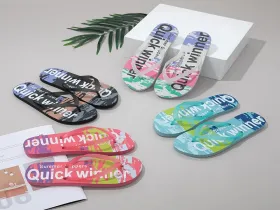
Cut-out brand shapes appear across the catalogue in different forms. Hollow cut logo flip flops carry a perforated mark through the sole, where stroke width governs durability under foot traffic. EVA foam cheering hands are die-cut to customer outlines and take screen-printed logos on faces that would otherwise be too narrow to print cleanly. Both are the same geometry problem, solved once in review instead of repeatedly in production.
Bringing the four numbers into your next order
Before an enquiry goes out, confirm four values on the drawing: sheet thickness with tolerance, minimum stroke width, minimum inside corner radius, and the marking method. A supplier who reviews those four points before tooling saves you a sample round; a supplier who does not will discover them at your cost.
Fulikai has manufactured custom EVA foam components from customer drawings since 2008, with in-house foaming, cutting, stamping and laser processing. Every order goes through 16 types of tests during production and full manual inspection before shipment, and third-party inspection and buyer factory audits are supported.
Send your artwork and target thickness to a
custom EVA foam manufacturing team and request a linework review covering corner radius and stroke width before tooling. Contact details are on the
Contact Us page.