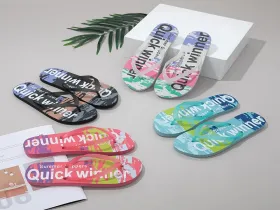
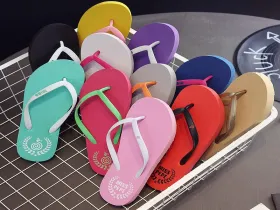
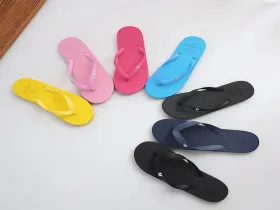
A hollow-cut logo flip-flop is a piece of promotional footwear with real marketing value: the brand mark is cut through the EVA sole, so the footprint it leaves on sand, wet stone or dust repeats your logo long after the wearer walks away. That is exactly why these shoes show up at beach activations, resort openings, festival giveaways and logo reveal campaigns where the reveal happens on the ground rather than on a banner.
Because the campaign depends on large quantities of pairs arriving in good condition and being handed out fast, the carton specification matters as much as the artwork. A pair that deforms in transit, or a case that cannot be opened and sorted quickly at an event booth, will quietly cost you impressions. The checklist below covers the carton details worth locking down before you place the order.
Start with what is inside the pair
Carton planning only works once the product construction is fixed, because the two drive each other. On our EVA frame flip-flops, for example, the sole is coloured EVA and the thong can carry a screen-printed, epoxy-coated or custom-moulded logo, while the hollow-cut logo itself sits in the sole. Size range is another early decision: these models are produced in adult and children's sizes, and a mixed size run changes how pairs nest inside the case.
Three product facts shape the packing plan:
- Cut depth through the sole. A hollow cut removes material where the logo sits, so the wall thickness around each letter or icon is what keeps the pair holding its shape under load. Ask your supplier to review fine linework and tight counters — the enclosed spaces inside letters such as o, a and e — before tooling, because a mark that reads on screen can be too delicate once it is cut out of foam.
- Sole softness. Soft, high-rebound EVA is comfortable to wear but vulnerable to permanent compression if cases are stacked carelessly or shrink-wrapped under load. That is the most common reason event stock arrives looking already worn.
- Strap type. PVC, rubber and fabric thongs behave differently when pairs are stacked heel-to-heel; a soft strap can crease against a neighbouring sole over a long ocean leg.
The carton specification sheet to agree on
Get these items confirmed in writing with your custom EVA foam manufacturing partner, and treat them as part of the order rather than an afterthought.
| Carton detail | What to specify | Why it decides campaign success |
|---|
| Pairs per carton and size ratio |
Pairs per case, whether cases are single-size or mixed, and the size curve across the run. |
Single-size cases make event distribution simple — staff grab one size and go. Mixed cases save space but need sorting time on site. |
| Inner packaging |
Whether each pair goes into an OPP bag, a header card, or nothing at all. |
Bagged pairs keep soles from rubbing and make the giveaway look finished. Unbagged pairs cut cost and waste for mass hand-outs. |
| Carton size and gross weight |
External dimensions, total pairs, and weight per case. |
Two people should be able to lift and carry a case around a venue. Overweight cases slow down booth crews and raise handling damage. |
| Carton grade |
Paper grade and ply count, plus stacking strength for the container load you plan. |
EVA foam is light, so a container usually fills by volume rather than by weight — but a soft case still bulges and collapses over a long ocean leg. |
| Nesting and orientation |
How pairs are laid: nested sole-to-sole, heel-to-heel, or flat in layers. |
Correct nesting prevents the hollow-cut edges from being pressed against a neighbouring sole and distorting. |
| Moisture protection |
Carton liner or poly bag, and whether the shoes are fully dry before closing. |
Foam that is sealed in while damp can develop odour and surface film inside the case before the event. |
| Marking on the outside |
Size label per case, quantity, lot reference, and handling marks such as "do not stack" if needed. |
Campaign stock is often split across venues. Clear case marking means nobody opens thirty boxes to find a size 9. |
| Pallet pattern |
Cases per layer, layers per pallet, and corner protection if cases are tall. |
A stable pattern protects the top layer of soft-foam product from being crushed under the layer above it. |
Protecting the cut logo in transit
The logo is the whole point of the campaign, so treat the cut area as a structural feature rather than decoration. In practice that means asking your factory to confirm how the pairs sit inside the case relative to the cut zone, and rejecting any packing method that lets two soles press their cutouts together. If your mark contains thin strokes or small counters, ask for a pre-production review of the artwork at actual size before the plate is made; our team reviews submitted drawings and samples and suggests adjustments to linework where needed so the finished cut survives both wear and packing.
A practical test worth running on your own sample order: pack a full case exactly as proposed, leave it loaded for a few days, then open it and check the cut edges for distortion. It costs almost nothing and tells you whether the case grade and nesting method are right.
Timing details that sit behind the carton
Carton planning is also a scheduling decision, because packaging changes arrive late if they are not raised early. Our published custom workflow runs from needs consultation through proposal and quotation, design drafts and renderings, mould opening and print moulding, signature confirmation, and then the deposit on signing the contract. Plate-making takes around 5–7 days, and bulk orders can be delivered within 15 days — so if you need a different case size, printed case artwork, or retail-ready header cards, raise that at the quotation stage rather than after production starts.
On quality, production runs pass in-process testing across 16 test types plus full manual inspection before shipment, and we support third-party inspection and buyer factory audits. If your campaign stock is being shipped to several venues, that is the point to confirm which lot goes into which carton, so a case label maps back to a production batch.
A short pre-order checklist
- ▭ Artwork reviewed at actual cut size, with thin strokes and counters confirmed as cuttable
- ▭ Size range and per-case size ratio agreed for the distribution method you will actually use
- ▭ Bagged or unbagged pairs decided, with inner packaging specified on the purchase order
- ▭ Carton dimensions, weight per case and paper grade confirmed in writing
- ▭ Nesting orientation agreed to protect the cut logo, verified with a packed sample
- ▭ Case labelling scheme agreed for split deliveries across venues
- ▭ Pallet pattern and container loading plan agreed before production starts
The pair is the media
Hollow-cut logo flip-flops work because they turn ordinary foot traffic into a repeated brand impression, which is why they have become one of the more distinctive items in our hollow cut logo flip flops range for brand clients. Get the artwork cut cleanly and get the carton right, and the campaign arrives ready to hand out. As a Shenzhen factory producing custom EVA foam products for overseas brands, agencies and gift companies, we handle both sides of that problem — tooling the cut and packing it so it lands intact. Send us your logo and event date, and we will come back with a proposal, quotation and a packing plan you can check against your venue logistics.