A museum gift shop rarely buys one item at a time. A single exhibition launch may need a themed mask, a sun hat or visor in the same palette, and a small run of matching keepsakes — all in quantities that are too large for a craft supplier and too small for a container program. That is exactly the situation a pilot order is meant to solve: one tooling decision, one colour standard, one delivery window, and enough units on the shelf to find out whether the theme sells.
Two details decide whether that pilot looks premium or cheap on the shelf, long before anyone reads the price ticket: how the cut edge of the foam is finished, and how the printed artwork sits on the surface. Below is how we suggest a retail buyer assess both, using our own EVA children's mask and EVA sun hat as the reference points.
Why museum shops start with masks, hats and visors
Costume pieces and headwear travel well, need no sizing chart beyond an adjustable strap, and photograph instantly against exhibition imagery. Our children's masks are supplied in two standard formats — 148 × 150 × 4 mm and 200 × 200 × 4 mm — with sizes adjusted to your artwork, an adjustable elastic strap to cover a range of head sizes, and silkscreen or heat-transfer printing for the theme. They are used for birthday and costume parties, school and stage activities, and seasonal events, which is why the same tooling often carries through a whole year of shop promotions.
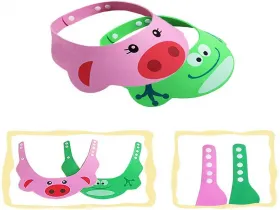
The sun hat works alongside it. It is die-cut from EVA sheet, with knitted fabric laminated to the inner side for comfort and a hook-and-loop fastener at the back so one SKU fits children and adults. Visor-style shapes, custom sizes and printed logos are all handled the same way, and each piece ships in an individual OPP bag — useful when the shop wants an open bin rather than boxed stock.
Because both items come from custom EVA foam manufacturing to your drawings or samples, a pilot order is normally defined by artwork and quantity, not by whether the factory can make the shape.
How to judge edge trim on a die-cut foam piece
The cut edge is where an unexperienced buyer and a retail buyer look at the same mask and see different things. When you inspect samples, check four points:
- Corners and contours. Fine interior detail in a themed design — a mane, a fin, a leaf edge — is where a die starts to lift foam. Ask for the tightest radius in your artwork to be reproduced on a physical sample before you sign anything off.
- Feel of the edge. Run a thumbnail along the perimeter. A finished piece should read smooth and rounded, with no raised burr and nothing sharp enough to catch skin or a paper tag.
- Edge-to-print registration. On a mask or visor the artwork sits close to the silhouette. Sight the piece against a light background: the print should follow the contour evenly all the way round, not creep toward one side.
- Thickness through the cut. A 4 mm sheet behaves differently from a thinner one — thick enough to hold its shape and resist snapping in a child's hands, thin enough to fold flat into a carrier bag. Confirm the gauge you are being quoted against the size of the piece.
On our side these points are controlled at the tooling stage. Shapes are produced by stamping and laser cutting, both available in our Shenzhen factory, which runs its own foaming, cutting, stamping and laser lines across more than 3,000 square metres. Our engineering team reviews submitted artwork before tooling and flags linework that will not cut cleanly — a detail that saves far more on a pilot order than it costs, because the correction happens before the die is opened.
How to judge print finish
Two methods are used for these products: silkscreen printing and heat-transfer printing. They are not interchangeable, and a pilot order is the right moment to decide which one your theme needs.
Silkscreen lays down a thicker ink layer with strong, saturated colour — a good match for flat, bold shapes such as cheering hands or simple mask graphics. Heat transfer carries full-colour illustration and fine gradations, which is what exhibition artwork usually asks for. Our self-developed heat-transfer process prints over a white base in multiple passes, so the EVA colour underneath does not show through the artwork; the site states colour fidelity above 95%, which you should verify on your own proof rather than take on trust.
Three checks tell you whether a print will survive a retail season:
- Rub and flex test. Bend the piece and rub the printed area firmly. Look for cracking along the fold line, or ink lifting at the edge of the design.
- Wash behaviour. Masks are wiped or hand-washed in water below 30 °C and air-dried. Ask how the print behaves after a wash, not just as it arrives.
- Colour match against your palette. Foam colour is formed during one-step foaming with masterbatch, so the substrate can be matched to your theme rather than printed over. Tell us the destination country and we will recommend raw materials that meet the standards applying there.
One practical note on both items: EVA can carry a slight smell when first unpacked, which clears after the packaging is opened and the piece is aired. It is worth mentioning in your shop's own guidance rather than leaving a visitor to notice it.
What a pilot order actually costs and takes
For masks and hats, sample charges are quoted per design and depend on the artwork; samples take 5–7 working days. Plate-making runs in the same 5–7 day window, and bulk production after sample confirmation is quoted at 25–30 working days, subject to the order. Payment follows a 30% advance with the balance released after pre-shipment inspection passes.
Quality control is documented rather than promised: 16 types of test during production — colour fastness, tensile strength, ink environmental testing and children's product safety among them — followed by full manual inspection before shipment. We support 100% third-party inspection and welcome buyer audits, and hold factory audit reports from Coca-Cola, Walmart and Sedex.
A caution on quoted lead times
Our pages state different production windows in different places: 5–7 days for plate-making against a five-day plate-making offer, and bulk delivery within 15 days against the 25–30 working days quoted on the mask product page. Treat those as ranges to be confirmed in writing for your order rather than as one fixed number. For a museum launch tied to an opening date, agree the dates at quotation stage and put them in the contract.
Before you place the pilot
Send us the artwork — vector preferred — with the theme colours, the quantity band you are testing, and whether the pieces will be sold loose or bagged. We return a quotation, design drafts and renderings, then tooling and print samples for sign-off before any bulk run starts. If you would rather see how we handle complex multi-process work first, our Monster Jam custom EVA cheering hands case sets out a tight-deadline production run from sample to full delivery.
Shenzhen Fulikai Packaging Products Co., Ltd. — contact us with your theme and quantity band, and we will quote the masks, hats and visors as one pilot order.