Can buyers reuse letter and number inventory from an earlier project for foam bath letter and number sets?
Yes. In most cases a set of letters or numbers you already paid for can be reused on a later order — but only when the character geometry, sheet thickness and print method still match what the new SKU needs. The die is usually the expensive part of an alphabet program; the artwork plate is not. Before you ask your supplier to "use the old tooling again", work through the checks below so you know exactly which costs carry over and which ones do not.
What a previous project actually leaves behind
A bath alphabet order normally produces three separate assets, and each one behaves differently when it sits idle between orders:
- The cutting die or laser file. Fulikai cuts custom shapes by stamping and laser cutting from your drawing or sample. The die is a physical tool held at the factory; the vector file can be re-output at any time. If the character outline on the new SKU is identical, this asset transfers intact.
- The heat-transfer print plate. Printing on EVA foam uses self-developed heat-transfer technology with multi-pass white-base printing, so the colour sits on the foam rather than soaking into it. Plates are inexpensive compared with a die — our published custom-capability page describes sample plates as costing only a few hundred dollars, with a five-day plate-making turnaround.
- The colour formula. Colour is introduced at the foaming stage through masterbatch, so an exact Pantone match from a previous run can be repeated without a new compounding job — provided you use the same base foam grade.
The practical conclusion: reusing an old letter set usually saves tooling money and one round of sample approval. It does not automatically save anything on printing, because a fresh plate is cheap and quick to make anyway.
Four checks before you approve the reuse
| Check | What has to match | If it does not match |
|---|
| Glyph geometry | The exact outline of each letter and number, including stroke width and corner radius. | A new die is required. Rounded corners matter: our bath sets are specified with smooth, burr-free edges, so a re-cut has to reproduce that profile. |
| Sheet thickness and density | The gauge the old die was built for, plus foam hardness. | A die cut for a thinner sheet can crush or feather a thicker one. Confirm the gauge before quoting reuse. |
| Finished character size | Overall height per piece. Our listed bath letter sets are specified at roughly 3 inch, while our EVA alphabet set is specified at 2.5–3 inch. | A size change means a new die and a re-check of the pack layout and any mesh bag or window box. |
| Print versus plain cut | Whether the earlier project printed letters onto the foam or cut the letter shape itself. | These are different processes. A cut-letter die cannot be swapped into a printed-letter SKU without re-engineering the artwork and registration. |
Where reuse breaks down in real orders
Three situations come up repeatedly with alphabet SKUs, and each one changes what "reuse" means:
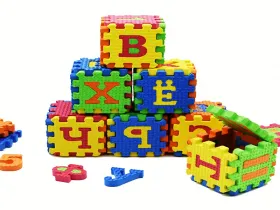
- script or language change. Latin A–Z tooling does not carry over to a Cyrillic or Spanish set. Our multilingual EVA foam alphabet puzzle mats are listed as two separate language SKUs for exactly this reason — the character inventory differs, not just the print.
- Set composition changes. A 26-piece set (A–Z only) and a 36-piece set (A–Z plus 0–9) share twenty-six dies but need ten new ones. Our EVA foam bath letters and numbers is listed at 36 pieces: 26 uppercase letters plus 10 digits. Extending an older A–Z program to a 36-piece count is therefore a partial, not a full, reuse.
- Substrate change. Magnetic foam letters for a fridge surface and floating bath letters that stick to a wet tub wall are different products with different adhesion behaviour. Our magnetic alphabet puzzle carries a full magnetic backing on every piece, which a plain bath letter die does not accommodate.
Rule of thumb: if the character outline, thickness and size are unchanged, expect to pay for material, printing and labour only. If any one of those three moves, budget for a new die and a fresh sample round before you commit the order quantity.
How to hand over old inventory cleanly
The fastest way to confirm reuse is to give the factory something physical plus something written. Send:
- A sample piece from the previous production run, not a pre-production prototype — the die has wear you want reflected in the new batch.
- The original drawing or vector file with its dimension callouts, if your team still holds it.
- The reference number of the earlier order, so the factory can pull the stored die and check its condition.
- Your destination country. Raw material selection is market-dependent, and we recommend foam grades that meet the applicable national standard rather than assuming last year's formula still applies to a new market.
With those four items the review step is short: our service team checks the drawing against the stored tooling, flags any detail worth changing — linework and corner radius are the usual candidates — and returns a proposal with the quotation. That is the same consultation-to-quotation sequence used for brand-new programs, just with one line item removed.
What still has to be re-approved even when the die is reused
Reusing tooling does not skip the approval steps that protect a retail listing:
- Print proof. A new plate means a new proof. Heat-transfer results shift with foam colour and batch, so approve a printed sample before bulk runs.
- Colour match. One-step foaming with masterbatch gives consistent colour, but a different base resin or a different market grade can move the shade. Approve against your physical reference piece.
- Packaging and piece count. Changing from 26 to 36 pieces changes the bag, insert and carton count. Our alphabet sets are supplied in mesh bags with suction cups on some configurations, so pack layout is part of the change, not an afterthought.
- Testing. Every production run passes through our in-process tests — colour fastness, tensile strength, ink environmental testing and children's product safety testing among them — and every shipment goes through full manual inspection before dispatch. A reused die does not reduce that scope.
Cost and timing you can plan around
With tooling already on site, plate-making takes 5–7 days and bulk production can be delivered within 15 days. Without a new die to cut, the front end of the schedule shortens by roughly the length of one sample-approval loop. For buyers restocking a proven SKU season after season, that margin is often the difference between making a promotional window and missing it.
Bring us your old set. If you have letter or number inventory from an earlier project, send a sample piece and the original artwork to
our custom EVA foam manufacturing team, or call +86 13827489472. We will tell you which tools can be reused, what has to be re-cut, and what the order actually costs — before you place it.