A private label EVA item that sells in one country does not automatically sell in four. The product itself rarely fails first; the packaging, the print, and the paperwork do. That is the moment when it becomes worth paying a manufacturer who foams, cuts, prints and packs under one roof — because one accountable party can change a tile size, a language panel or a substrate without restarting your whole launch calendar.
What "in-house" actually covers in EVA foam
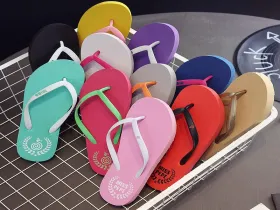
In this category the phrase gets thrown around loosely. For an EVA foam products manufacturer such as Fulikai, in-house means the production lines for foaming, cutting, stamping and laser processing sit in the same Shenzhen building of more than 3,000 square meters. The sheet is expanded with the colour masterbatch already added, so the colour runs through the material rather than sitting on the surface. Shapes are then stamped or laser cut from customer drawings or samples.
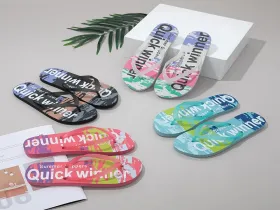
The part that matters most for retail-ready goods is the printing. Fulikai uses self-developed heat-transfer printing with multi-pass white-base printing, so the base colour of the foam does not show through the artwork. Compare that with a supplier who outsources decoration: your print house and your foam house will argue about whose fault a soft-edged logo is, while your launch date slips.
A practical test when you screen suppliers: ask who owns the plate, who owns the mould, and who signs off the colour. If three different companies answer, expect three queues.
The multi-country reality that makes it worth paying for
Selling the same SKU in several markets means repeating compliance work per market — the EU under EN-71 and REACH, US toy requirements, Japan and Korea quality norms — plus local language packaging, different retailer inspection regimes, and a planogram that assumes carton sizes you can no longer change cheaply. This is where integrated capability earns its premium.
Fulikai's stated approach to raw materials is instructive here: tell the factory your destination country and it recommends a substrate that meets that market's national standards. That single sentence replaces a lot of internal work for a brand without a materials engineer on staff. The factory holds ISO 9001:2015 certification and CE, EN-71, FDA, FCC, RoHS, SGS and REACH certifications; the applicable certificate or test report still has to be confirmed per product, market and order before you put any compliance claim on a carton.
Where in-house packaging capability pays back
- Foldable formats. A hanging header card plus a fold that must survive retail handling is a structural problem, not a print problem. It needs lamination and cutting in the same place.
- Language panels. Four or six language blocks change tile copy but not tooling — only if the decoration step is under the same roof.
- Retail-ready packaging. A US big-box order can demand full manual pre-shipment inspection and an audit trail. Fulikai supports 100% third-party inspection, runs 16 types of tests during production (colour fastness, tensile strength, ink environmental testing, children's product safety testing) and holds factory audit reports from Coca-Cola, Walmart and Sedex.
- Assortment depth. A retailer wanting a Spanish version next to an English one is asking for a new plate, not a new factory. Fulikai quotes plate-making at 5–7 days, with sample plates costing a few hundred dollars.
A concrete example: two language SKUs from one tooling set
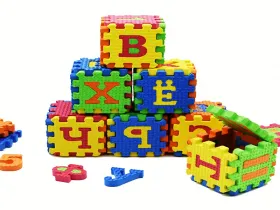
Take the multilingual EVA foam alphabet puzzle mats already in the Fulikai catalogue. One 36-piece interlocking format ships as two language SKUs — Russian Cyrillic and Spanish Latin, with removable letter and number inserts, tiles at 5.5 × 5.5 cm and a compact retail package. The geometry, tooling and foam are identical; only the printed faces differ.
That is exactly the pattern a brand launching into several countries wants: one product platform, many market variants, no new mould per market. If your supplier cannot do the decoration in-house, each variant becomes a separate sourcing project with its own minimum order and its own defect profile.
When it is not worth paying for
Integrated capability has a cost, and honesty helps here. You do not need it when:
- You are buying an existing catalogue item with plain packaging and no artwork — a converter or trading company will be cheaper.
- Your variant count is one market and one SKU with a long reorder horizon; there is nothing to iterate on.
- Your product needs processes the foam factory does not run. Fulikai's own Skip Hop case shows the limit of this logic: the brand later asked Fulikai to handle domestic procurement and packing of vinyl products, which are outside its core competency — an act of trust, not a service promise you should assume.
A foldable bath puzzle: screen printing on one side, heat-transfer printing on the other, double-sided lamination for precise fitting, and foldable packaging that needed its own structural design. The incumbent supplier declined the order; sampling elsewhere took the brand nearly half a year without success. Fulikai's R&D team delivered the sample three days ahead of its committed week. —
Skip Hop cooperation caseHow to price it properly in your launch model
Do not compare unit prices alone. Build a small comparison sheet per market, and let the differences you can actually control drive the decision.
| Cost line | Split-supplier model | Integrated EVA manufacturer |
|---|
| New market variant (language or artwork) | New decoration vendor, new MOQ, new lead time | New plate in 5–7 days; tooling unchanged |
| Compliance substrate per destination country | You research and specify it yourself | Factory recommends material for the stated market |
| Retail inspection and audit readiness | You arrange everything from scratch | 16 in-process tests, full manual pre-shipment inspection, third-party inspection supported |
| Defect disputes between foam house and print house | Split accountability, slow resolution | One accountable production floor |
| Replenishment after a sell-out | Several queues to re-order | Bulk orders delivered within 15 days per the factory's stated lead time |
Then add the two numbers suppliers rarely advertise: iteration cost and failure cost. A plate at a few hundred dollars is trivial next to a missed seasonal planogram in four countries.
A short decision rule
Pay for in-house capability when you expect to change things — more markets, more languages, retailer-driven packaging changes, seasonal restocks. Pay less and accept a split supply chain when the specification is frozen. The dividing line is not order size; it is how many times you expect the artwork or the compliance substrate to move before the product settles.
What to send in your first enquiry
- Destination countries for the SKU, so material selection matches each market's standards.
- Your drawing or physical sample, plus the retail packaging format (hang header, fold, window, carton).
- Variant list: languages, colourways, print areas on each side.
- Which certificates your buyer will ask for, so the right test report is booked early rather than after production.
Fulikai's custom order process runs through needs consultation, proposal and quotation, design drafts and renderings, mould opening and print moulding, signature confirmation, then a 30% deposit on signing — a sequence that fits a multi-market launch because the variant decisions are made before tooling, not during production.