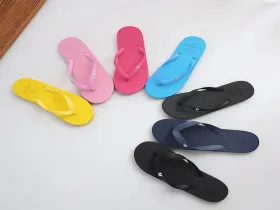
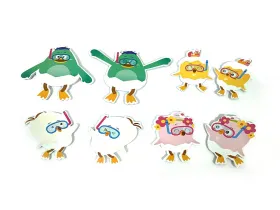
A tourism distributor that resells printed beach footwear usually carries several destination brands at once: hotels, resort groups, tour operators, gift shops and event organisers. Each one wants its own illustration on the strap or footbed, and each one wants it before the season opens. That is exactly where the decision between a stock design and an OEM build becomes urgent rather than theoretical. The short answer: buy stock when the print is decorative and the delivery date is fixed; go OEM when the artwork itself is the asset being sold. This article sets out the specific conditions that decide which route to take, and what each one changes in tooling time, colour control and reorder flexibility.
What "stock" and "OEM" actually mean for a printed flip-flop
The two words get used loosely, so it is worth fixing the definitions before comparing them. A stock model means the sole shape, the strap construction and the size range are already tooled and running. The variables left to you are colourway, print artwork from the designs we already hold on file, and quantity. Nothing new has to be cut, stamped or plated before production starts.
OEM means the product is built to your drawing or physical sample. At Fulikai that covers custom shapes produced by stamping and laser-cutting, one-step foaming with colour masterbatch so the base foam itself carries the colour rather than a surface coating, and heat transfer printing on EVA foam on the upper. Our custom EVA foam manufacturing page describes the process in full, including the design review step where our team marks up your linework before anything is cut.
For a tourism distributor this distinction matters because it decides who owns the artwork. A stock print can be bought by anyone who walks in with the same order. An OEM print, especially one with a hollow-cut logo through the sole, cannot be reordered elsewhere without your files.
Five conditions that point to stock designs
1. The season date is already fixed
Resort and attraction merchandise sells in a narrow window. If the buyer needs pallets on the shelf for a school-holiday or summer programme, the tooling stage is what kills the schedule, not the production run itself. Stock models skip it entirely.
2. Several small buyers are sharing one container
A distributor consolidating orders for a dozen gift shops cannot give each of them a separate tooling cycle. Stock models let you split one purchase order across colourways and prints without multiplying lead time.
3. You need shelf continuity, not exclusivity
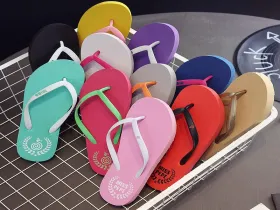
Some accounts want the same plain colourway restocked every season regardless of artwork. Stock is the right answer there: the sole and size range are already running, so a reorder is a purchase order rather than a project.
4. The illustration is mood, not identity
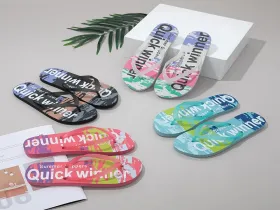
Palm silhouettes, graffiti lettering, tropical patterns and generic novelty graphics, like the two print options on our Quick Winner printed EVA flip-flops, do a decorative job. Nobody is protecting that artwork, so paying to develop it exclusively buys you nothing.
5. You are testing an unproven market
When a new destination or attraction has no sales history behind it, the cheapest way to learn is to put existing prints on shelves and watch what moves. That keeps your exposure at the cost of goods instead of tooling plus goods.
Five conditions that point to OEM
1. The buyer's logo is the product
A hotel group or theme park paying for its own mascot on the footbed is buying exclusivity. Our custom logo flip flops line covers logo application by screen printing, epoxy coating on the strap, custom mould fabrication, and hollow-cut logos through the sole. A cutout mark reads in sand, which is why it works well for beach and resort programmes; the hollow cut logo flip flops case shows how that looks on the ground.
2. The illustration has fine linework or sits on a pale base foam
This is where stock printing quietly disappoints: thin-line artwork loses detail against the foam's own grain, and a dark sole flattens a light design. Our self-developed heat-transfer process prints with no underlying base colour showing through and holds over 95% colour fidelity, with multi-pass white-base printing underneath saturated artwork. If your tourism client's mascot is the whole point of the design, that is an OEM decision, not a decoration decision.
3. The buyer needs a specific size ladder
Kids' resort programmes and family attractions need children's sizes alongside adult runs. Stock colourways come as they come; our custom toe-post flip-flops are made in adult and children's sizes to the split you specify.
4. Compliance is specified by the destination market
If your buyer's procurement team asks for materials matched to their national standards, tell us the destination country and we will recommend raw materials that meet it. Our Shenzhen factory runs to ISO 9001:2015 and holds CE, EN-71, FDA, FCC, RoHS, SGS and REACH certifications, with 16 types of tests through production including colour fastness, tensile strength and children's-product safety testing. Confirm the certificate that applies to your specific product and market before quoting it to your buyer.
5. You intend to reorder the same design repeatedly
Once a design has proven itself, the tooling is already paid for and every repeat order skips the plate-making stage. A stock colourway never builds that kind of continuity.
Stock versus OEM: the decision factors
- Time to shipment. Stock is the shortest path because there is no plate-making step. OEM adds plate-making, quoted at 5 to 7 days, before bulk production starts.
- Artwork ownership. A stock print is shared with any buyer who orders the same artwork. An OEM build is yours: sole shape and logo cutout can be exclusive.
- Colour control. Stock is limited to existing colourways. OEM colours the foam itself with masterbatch and adds a multi-pass white base under saturated artwork.
- Fine linework on pale artwork. Risky on textured or dark soles from stock; OEM is set up for it, with no base colour bleeding through the print.
- Size split. Stock follows the running size range. OEM takes the adult and children's ladder you specify.
- Order pattern. Stock suits one-off or seasonal top-ups. OEM suits designs that repeat across seasons, because tooling is paid once.
How the choice changes your position with the buyer
The route you pick reshapes what you are actually selling. Stock makes you a fast supplier: useful when a resort group needs pallets before opening weekend, but replaceable, because the same print is one enquiry away from their next distributor. OEM makes you the only source for that artwork, so it is slower to start and harder to displace once it sells.
A practical rule for tourism distribution: let the buyer's own artwork decide. If the illustration can be swapped for another and nobody objects, buy stock. If removing the illustration removes the sale, build it OEM.
The hybrid route most distributors end up using
In practice the split is rarely all-or-nothing. A workable pattern is to hold a few stock models as fast-moving filler for walk-in and emergency orders, while running OEM only for accounts whose artwork carries margin. The stock line protects your delivery reputation; the OEM line protects your account list.
If you go that way, keep the OEM brief short and specific before you send it. Our custom EVA product order process runs through needs consultation, a proposal and quotation, design drafts and renderings, mould opening and print moulding, signature confirmation, then a 30% deposit on signing. The rendering review is the stage worth slowing down at: that is where you catch artwork that will not hold up on a textured footbed, before any tooling is cut.
What to send us for an accurate OEM quotation
- The artwork in vector form, with the colour breakdown your brand uses. A raster screenshot forces guesswork on line weights.
- Where the logo sits: strap, footbed, or hollow-cut through the sole. Each has a different process and cost.
- Destination country, so we match raw materials to that market's standards rather than assume.
- The size ladder you need, including whether children's sizes are part of the run.
- Total quantity per design, not across designs, because tooling is amortised per artwork rather than per order.
- Your ship-by date, so we can tell you honestly whether OEM fits the calendar.
Frequently asked questions
Can a stock model still carry my logo?
Yes. Logo application on a stock sole is available by screen printing, epoxy coating on the strap, embossing on the footbed, or a hollow-cut mark through the sole. What you are not buying is the exclusive shape.
Does an OEM print fade at the beach?
The prints on our printed EVA lines use water-resistant ink and are meant for rinse-and-air-dry care. Buyers should still keep the flip-flops out of prolonged direct sunlight in storage, since heat and UV age the foam itself rather than the print.
Which route is cheaper per pair?
Stock, on the first order, because there is no tooling to absorb. OEM usually closes the gap on the second and third orders of the same design, since plate cost appears only once. Ask us for both quotes against the same quantity and compare them across three reorder cycles, not one.
Can I change my mind mid-project?
You can move from stock to OEM before mould opening. Moving from OEM back to stock after plates are made means the tooling spend is already committed, so confirm at the rendering stage.
As a Shenzhen EVA foam products manufacturer working with advertising agencies, gift companies and design firms since 2008, we quote both routes on the same enquiry. Send us the artwork and the ship-by date and we will tell you which one actually fits.
Fulikai Order Hotline: +86 13827489472 | Send an enquiry