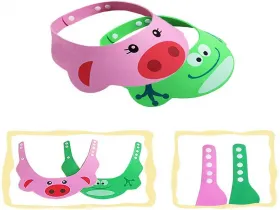
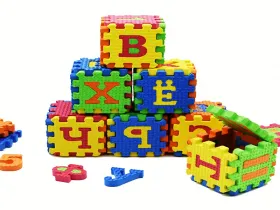
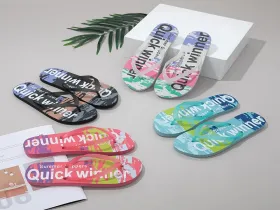
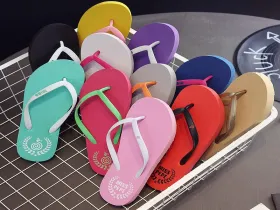
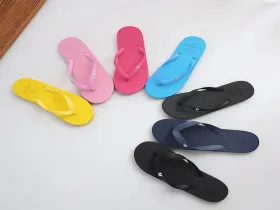
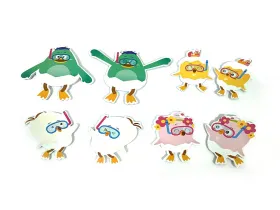
A private label EVA range lives or dies on decisions you cannot undo later: the tooling you commit to, the print process behind your artwork, and whether the factory can prove material compliance for the market you ship into. This guide sets out the evidence a distributor should ask for at each stage of custom EVA foam manufacturing, and what “good” looks like in each answer.
Why private label buyers end up with a shortlist that all looks the same
EVA (ethylene-vinyl acetate) foam is easy to quote and hard to specify. A dozen suppliers will send you almost identical numbers for a bath puzzle, a promotional flip flop or a cheering hand, because the product categories are simple and the raw material is close to commodity. The differences only surface after you have paid for tooling: colour drift between lots, print that lifts after a few washes, packaging that fails a retail drop test, or a certificate that does not match the destination country.
For a distributor launching a private label range, the real risk is not the unit price. It is the cost of a second attempt — new plates, new molds, a missed seasonal window, and dead stock in your warehouse. So the shortlisting question should never be “who is cheapest”, but “who can show me evidence that the first attempt will pass”.
Evidence check 1: proof they work from your drawings, not their catalogue
A genuine custom factory starts with your files. Ask what happens to a drawing or physical sample when it arrives, and listen for specifics about process rather than promises about speed.
- ✓Shape and cutting methods. Ask which processes are in-house. Stamping and laser-cutting cover most private label shapes; if a supplier only offers catalogue sizes, they are trading, not manufacturing. Fulikai produces shapes and colours by stamping and laser cutting from customer drawings or samples.
- ✓A design review you can read. Request written feedback on your artwork before any tooling is cut. A capable team comments on linework, minimum detail sizes and what will not reproduce at scale — the kind of input that prevents an expensive rework later.
- ✓Samples from a real production route. Ask how long sampling takes and whether the sample uses the same material and print method as production. On Fulikai product pages the stated sample time is 5–7 working days, with bulk lead time quoted at 25–30 days after sample confirmation on items such as bath puzzles and toe separators; treat any figure as a quotation for your specific item, not a guarantee.
Evidence check 2: the colour and print process behind your artwork
Private label means your colours. Two details decide whether they survive mass production.
Where the colour is created
Ask whether colour is added during foaming or painted on afterwards. One-step foaming with colour masterbatch makes the colour part of the sheet, so cut edges and chamfers match the surface — important for foam toys, mats and cheering hands where the edge is visible. Fulikai describes colours formed in one-step foaming with added colour masterbatch, from a full range of foam materials supplied through long-term partnerships with upstream suppliers.
Which print method is used, and how the plate is paid for
Screen printing and heat-transfer printing behave differently on EVA. Heat transfer with a white base is the option to ask about when your artwork contains light colours on a dark foam body, because it stops the base colour showing through. Fulikai uses self-developed heat transfer printing on EVA foam with multi-pass white-base printing for saturation, and quotes a 5-day plate-making turnaround with sample plates at a few hundred dollars. Ask any supplier three questions in writing: what is the plate cost, how long does it take, and does the plate carry over to repeat orders.
Always ask for a printed strike-off on the actual foam colour you have chosen, signed and dated, before bulk production starts. A colour approved only on paper or on a different sheet is not an approval.
Evidence check 3: compliance matched to your destination market
Certificates are where claims get loose in foam products. A supplier may hold ISO 9001 and a stack of test reports that have nothing to do with your product or your market.
- ✓Match the certificate to the product, not the company. A toy safety report on one SKU does not cover your pedicure slippers. Ask for the report number, the tested item name and the testing house.
- ✓Match the standard to the country. Children's products sold in the EU are handled differently from toys sold in Japan or the United States. Fulikai states that once you tell them your destination country, they recommend raw materials meeting the corresponding national standards — a useful test of whether a supplier actually works market by market.
- ✓Check the audit trail. Fulikai's Custom Capabilities pages state ISO 9001:2015 certification and list CE, EN-71, FDA, FCC, RoHS, SGS and REACH, while the About Us page refers to ISO 9001:2008. The site also mentions factory audit reports from Coca-Cola, Walmart and Sedex. Because these pages do not all agree on the same version, request the current certificate and the specific test report for your SKU before you repeat any claim on your own packaging or listing.
Evidence check 4: what inspection actually happens before shipping
Ask who inspects, when, and what they reject. “We have a QC team” is not an answer; a defined test list is.
Fulikai describes 16 types of tests through production — including colour fastness, tensile strength, ink environmental testing and children's product safety testing — plus full manual inspection before shipment and support for third-party inspection. The company reports an average defective rejection rate above 10%, which sounds like a weakness but is the honest signal: a factory that rejects nothing is not inspecting anything. See the inspection and factory audit page, and confirm your own arrangement in writing.
A practical term to look for: balance payment released after pre-shipment inspection is passed. On several Fulikai product pages the stated terms are a 30% advance with the 70% balance paid after pre-shipment inspection, which puts the supplier's money behind the quality result as well as yours.
Evidence check 5: capacity that protects your seasonal window
Private label ranges are seasonal. Foam cheering hands peak around events and match days; bath toys, flip flops and grass slippers peak in spring and early summer; heated slippers, boots and insoles move in autumn. A supplier who can only quote one lead time has not planned for that pattern.
Ask three concrete questions: how long plate-making takes, what the bulk delivery window is, and what happens if your event date moves. Fulikai states 5–7 days for plate-making and bulk delivery within 15 days on its Custom Capabilities pages, with in-house capacity reallocated for urgent orders and dedicated staff tracking the order end to end. Compare that with the 25–30 day production lead time quoted on individual product pages — both numbers can be true for different items and quantities, so pin down your own SKU's date before you commit stock.
One documented example of what real capacity looks like: for custom EVA cheering hands tied to a live event, the Monster Jam case study describes 80,000 pieces completed inside a 25-day window using two-shift production after other factories declined the print specification. That is not a promise about your order; it is evidence of how the factory behaves when a deadline becomes fixed.
Where to start a private label range with the least risk
The lowest-risk first order is usually a product you can see already made. Browsing finished samples tells you about print quality, edge finishing and packaging far faster than a specification sheet. Fulikai's Sample Center lists the range it has produced, and its custom sample pages group work by category: EVA educational toys, EVA nail products, household items and promotional goods.
If you sell through marketplaces or cross-border channels, the custom EVA foam products for cross-border e-commerce category is a direct reference point, since those SKUs are packaged and sized for retail listings rather than bulk industrial use.
Two examples of private label work already on the site show how much differentiation foam allows. Hollow-out logo flip flops carry a cutout brand mark in the sole that leaves a distinctive footprint — a design feature that adds identity without changing the material. And the Skip Hop bath puzzle case shows what happens when a specification defeats other factories: double-sided printing, lamination and foldable packaging took that buyer half a year of failed sampling before production was signed off.
The shortlisting questions to send with your RFQ
| Ask this | What a good answer contains |
|---|
| Which processes are in-house? | Foaming, cutting, stamping, laser work and printing named specifically. |
| How is colour added? | Masterbatch in foaming, plus the colour standard used for approval. |
| Which print method for my artwork? | A recommendation with the reason, not a menu of options. |
| Plate cost, plate time, plate ownership | All three in writing, including repeat-order treatment. |
| Which report covers this SKU and market? | Report number, test house, tested item name. |
| Inspection scope and payment trigger | Test list plus balance released after pre-shipment inspection. |
| Lead time for my quantity and season | A dated plan, with what changes if the date moves. |
Score the answers, not the prices. A supplier who names processes, states plate economics and sends a report number you can verify is worth a premium; one who answers every question with “yes” is selling you a second attempt at your own cost.
Frequently asked questions
What minimum evidence should I requir