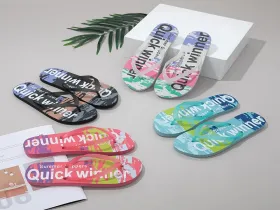
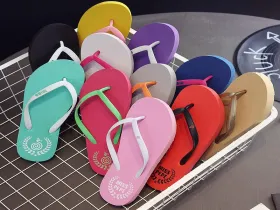
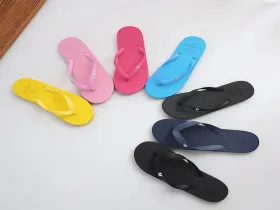
Two-tone EVA thong sandals — a contrast footbed paired with a coloured strap and outsole trim — are one of the easiest summer items to sell, precisely because they are easy to source. That is the problem. A dozen suppliers on a search page all show the same white-soled sandal with red, blue and green straps, all quoting in US dollars per pair, and none of them look alike behind that photo. Buyers who choose on the picture alone usually find out the difference later, when the strap colour drifts, the footbed grain stops gripping, or a container arrives two weeks past the shelf date.
This guide compares the two sourcing routes for this specific sandal — going direct to an EVA foam products manufacturer or buying through a trading company — and gives you the checks that actually decide the order: colour control, tooling, footbed texture, inspection access and lead time.
What is different about sourcing a two-tone sandal
A solid-colour flip flop can be produced from one batch of coloured foam. A two-tone thong sandal cannot. The footbed and the strap, and often the outsole trim as well, are separate components in separate colours, so the supplier has to keep three colour decisions consistent across every production run and every size range. That single fact drives most of the practical differences between a factory and an intermediary.
It also explains why two listings that look identical can behave very differently on the shelf. The contrast line between footbed and strap is where a buyer notices a mismatch first, and it is exactly where an outsource chain has the least control.
What a trading company actually gives you
A trading company aggregates products from factories it does not own. For a buyer this brings real advantages in some situations, and they should be acknowledged before the drawbacks are discussed:
- One purchase order across categories. If you need thong sandals, knee pads, bath puzzles and yoga blocks for a single summer programme, one counterparty consolidates them into one shipment and one payment.
- Catalogue breadth without factory outreach. You can compare many existing moulds in a week rather than contacting several producers.
- A familiar export process. Documentation, booking and communication are handled by staff who do this daily for many clients.
The limits follow from the same structure. The trading company does not control when a mould is opened, which masterbatch batch was used, or whether the printing plate for your logo has been made. It passes your request on and relays the answer. For an off-the-shelf colour in an existing mould, that works. For a sandal where your brand's colour has to match a Pantone reference across footbed, strap and trim, it adds a step between you and the people who can actually change something.
Where a direct EVA foam factory changes the outcome
1. Colour is made in-house, not chosen from a swatch book
Two-tone means colour-matching twice. At custom EVA foam manufacturing operations such as Fulikai's Shenzhen plant, the foam colour is created during foaming itself by adding colour masterbatch, so the target shade is set in the raw material rather than applied afterwards. That matters for a two-tone sandal in a practical way: the footbed keeps its colour through wear instead of wearing through a surface layer, and the strap can be matched to the same reference from a different component stock.
Ask any supplier one question and the difference becomes obvious: "which batch record will you show me for my footbed colour on the production run?" A factory names a batch. An intermediary asks your question again, by email, to someone else.
2. Logo options are decided by tooling, not by printing onto whatever exists
On a thong sandal the branding can sit in at least four places, and each needs a different capability:
- Screen printing or epoxy coating on the strap.
- A custom-moulded strap carrying an embossed mark.
- An embossed logo pressed into the footbed.
- A hollow-cut logo through the sole, so the mark reads as a footprint in sand — a technique used for promotional and branded flip flop orders.
Heat-transfer printing is the process that carries detailed artwork on the footbed. Where it is developed in-house, a white base is printed first so the artwork colour stays saturated instead of picking up the foam's own tone. A trading company can sell you any of these finishes; only the producer decides whether the plate exists and how quickly it can be cut.
3. Footbed texture is a mould decision
Two-tone beach sandals are sold on wet surfaces: pool decks, hotel bathrooms, spa showers, boat docks. The grip comes from the grain in the footbed — wave grain, fine particle grain, diamond cut or honeycomb — and that texture is formed by the mould. A supplier with in-house stamping and laser cutting can change it; a reseller of existing stock cannot, and neither can they tell you what the current mould's grain depth is unless the factory tells them.
4. You can inspect the line that makes your goods
Order-level quality control looks different from each side of the relationship. A manufacturer with its own production lines runs tests during production and a manual inspection before shipment, and accepts third-party inspectors and buyer audits on site. Fulikai's Shenzhen factory reports more than 3,000 square metres of production space, sixteen types of tests across the production cycle, full manual pre-shipment inspection, and audit reports from Coca-Cola, Walmart and Sedex.
With an intermediary you inspect the finished carton, not the process. For a low-cost consumable that may be acceptable. For a sandal carrying your brand into a retail season, the difference is whether a problem can still be corrected before the container leaves.
Side-by-side comparison for this product
| Sourcing factor | Trading company | Direct factory |
|---|
| Two-tone colour matching | Existing stock colours only; custom shades depend on the factory behind them | Masterbatch mixed for the target shade during foaming |
| Custom strap or footbed mould | Relayed request, no control over tooling schedule | Mould opened and print-moulded in-house |
| Hollow-cut logo sole | Rarely offered from stock | Cut or embossed to the artwork |
| Sample plate turnaround | Adds relay time to whatever the factory quotes | Plate-making quoted at 5–7 working days |
| Bulk lead time | Depends on the factory's queue plus coordination | Bulk delivery within 15 days once approved |
| Pre-shipment inspection | Finished goods only | In-process tests plus full manual inspection; third-party inspectors welcome |
| Assortment across unrelated categories | Convenient — one order, one shipment | Narrower unless the factory makes those items too |
| Price transparency | A margin sits between you and the production cost | Quoted from the production line |
When a trading company is still the right choice
Direct sourcing is not automatically better. Choose an intermediary when:
- You need small quantities spread across many unrelated product types, and no single factory's minimum order suits the mix.
- An existing mould and stock colour are acceptable, and speed to shelf matters more than specification.
- Your team has no one to handle export documentation and you want that covered in one contract.
Go direct when the sandal carries your colours, your logo, or a size and texture range that stock does not offer — and when the order is large enough that tooling and inspection access change your margin.
Five checks to run before you place the order
- Ask which factory produces the sample. Request the factory address and whether an audit or video walk-through is possible. A supplier who produces goods on site will arrange it; a reseller will negotiate.
- Order a physical two-tone sample, not a photo set. Check the strap colour against your reference under daylight, then check it again after the footbed has been flexed repeatedly — colour drift between components shows up on the finished pair.
- Test the footbed grain wet. Run your thumb over the surface with water on it. Wave grain, honeycomb and diamond-cut patterns grip differently, and a smooth footbed is not safe for pool or spa use.
- Confirm what the quotation includes. Plate-making cost, sample fee, packaging (OPP bag per pair, multi-pair packs, retail hang tags), size curve and whether the balance is due after inspection passes.
- Ask which certificates apply to your market and product. Test reports cover specific products and destinations, so request the report that matches your order rather than accepting a general list.
Practical note: for promotional runs, the hollow-cut logo option is worth requesting alongside a standard embossed footbed. The cut-out mark shows up in sand and on carpet as the wearer walks, which no printed logo does.
Where Fulikai fits for two-tone thong sandals
Shenzhen Fulikai Packaging Products Co., Ltd. makes custom EVA foam products in Shenzhen and exports to Japan, South Korea, Europe and the United States. For summer footwear specifically, the factory produces two-tone EVA flip flops with a white footbed and red, blue or green strap and trim, alongside solid-colour, tropical-printed and artificial-grass thong styles in adult and children's sizes.
Straps can be screen printed, epoxy coated or custom moulded; soles can carry an embossed or hollow-cut logo. Plates are made in 5–7 working days and bulk orders are quoted for delivery within 15 days after approval, with a 30% deposit on the signed contract and the balance after pre-shipment inspection passes. Buyers who want to see the process rather than trust a catalogue can arrange a factory audit or third-party inspection on site.
Send your artwork and get a two-tone sample
Share a drawing, a photo or an existing pair of sandals, and the service team will review the strap colour, footbed grain and logo option before quoting. Order hotline: +86 13827489472 · Make an enquiry · Sample centre