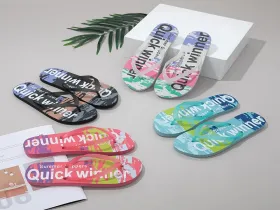
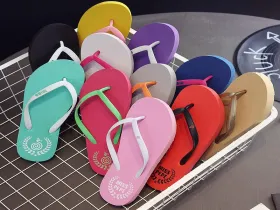
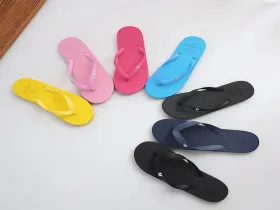
A frame flip-flop looks simple on a photo: one EVA sole, one thong strap, one logo. That simplicity is exactly why a repeat order goes wrong quietly. Nothing breaks, nothing fades - the shoe just sits differently on the foot than the approved sample did. This checklist walks through what to inspect in the first carton of a delivered batch, and which of those findings should stop a second purchase order until they are corrected.
Why frame flip-flops expose dimensional drift early
Our EVA frame flip-flops are built from a coloured EVA sole paired with a PVC, rubber or fabric strap, in adult and children's sizes, with the logo carried on the strap by screen printing, epoxy coating or custom mould fabrication, or hollow-cut into the sole. Each of those elements is made by a different process - foaming, stamping or laser cutting, strapping, printing - so the finished shoe inherits the tolerance of every one of them.
EVA is also a foam that has been foamed with colour masterbatch in one step. Its density and hardness decide how much a sole holds the outline it was cut to, and they can shift between compound batches even when the cutting tooling does not change. A first order that fits well therefore guarantees nothing about the second one unless you verify the geometry of the new batch against the reference you already hold.
Six measurements to take before you sign off a repeat order
Take five pairs at random from three different cartons, not the top pair of one carton. Lay every shoe sole-side down on a flat table and read each item below against your approved sample or the signed drawing.
| What to measure | How to check it, and what a fail looks like |
|---|
| Sole length and widest width | Measure heel point to longest toe point, then the widest span across the forefoot. Place the new sole directly on top of the approved sample and look for an outline that shows through at the toe or the outer edge. A visible crescent means the cutting contour moved. |
| Sole thickness | Read the stack height at the heel and at the forefoot on every pair. Thickness is what a buyer feels as comfort, and it changes with foaming density rather than with the tooling. |
| Strap anchor positions | Measure from each point where the strap enters the sole to the nearest side edge and to the toe tip. If those two distances drift, the strap pulls inward or sits too far forward, and the shoe twists on the foot even when the sole length is correct. |
| Strap height and tension | Press the toe-post down to the footbed and note how much spring returns, then hold the pair side on and sight along the strap. A webbing that sits flatter or looser than the sample changes fit before any dimension is wrong. |
| Left and right symmetry | Put the left and right soles toe to toe and compare their outlines. Any mirror mismatch points at a die or cutting fixture that has moved, not at a design problem. |
| Logo placement | Measure the printed or hollow-cut logo against the same fixed point on the sole in each pair. For a hollow-cut logo, also check that the cut edges are clean and open, not closed by foam that has relaxed back into the gap. |
Three defects that look cosmetic but are actually shape problems
Curling or cupping at the toe and heel. A sole that will not sit flat has internal stress from cooling after foaming or cutting. It is a geometry defect, not a storage crease, and it will not relax back within a retail season.
A footbed that reads harder or softer than the sample. Squeeze the heel with your thumb on the new pair and on the retained sample in the same session. Different rebound means different foam density, which is the usual cause of a shoe that loses its outline after a few weeks of wear.
A strap that prints or coats cleanly but sits off-centre. Printing registration and strapping jigs are separate settings. A logo that is sharp but shifted tells you the holding fixture changed, and the same fixture usually carries the anchor holes as well.
What to send back to the factory so the fix is precise
A message that says "the shape is different" gets a polite answer and no correction. Send four things instead, and the conversation moves to tooling in one round:
- The retained approved sample or signed drawing, with its date and reference number.
- Your measurements from the table above, in millimetres, for each pair you checked.
- One photograph of the new sole laid on top of the approved sample, shot straight down with a ruler in frame.
- The lot or production date printed on the carton, so the factory can trace which compound batch and which cutting line produced it.
Ask specifically whether the change came from the stamping die, the laser-cutting fixture, the strapping jig or the foam batch. Each has a different remedy and a different lead time, and naming the one you suspect stops the supplier from re-running everything.
Building the check into the order instead of after it
The cleanest version of this inspection is not yours - it happens before shipment. At Fulikai's custom EVA foam manufacturing service, products are produced in various shapes and colours by stamping and laser cutting from customer drawings or samples, and the review team flags design details such as linework before tooling is committed. Every production run passes 16 types of tests covering colour fastness, tensile strength and material safety, and full manual inspection is carried out prior to shipment with support for third-party inspection.
Two practical clauses are worth putting in the repeat purchase order. First, state your tolerance band on sole length, width and thickness in millimetres, so "consistent" is a number rather than an opinion. Second, ask for a retained sealed sample at signed approval, kept at the factory against which every later batch is compared. That single step turns an unpacking argument into a measurement.
If your repeat order is running close to a season date, plate-making takes 5-7 days and bulk orders can be delivered within 15 days, so there is usually room to correct a tooling fixture once the finding is documented. Send the measurements early and the correction happens inside the schedule; send them after the container is booked and you are negotiating instead.
Send us the drawing, a sample pair, or a photo of the pair that came in wrong.
We will compare it against our tooling records and tell you which fixture moved. Call +86 138 2748 9472, email sales@fulikaisz.com.cn, or use the inquiry form - Shenzhen Fulikai Packaging Products Co., Ltd., wholesale EVA flip flops, Longhua District, Shenzhen.