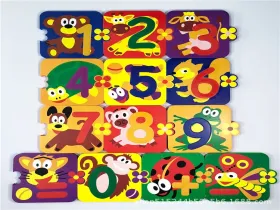
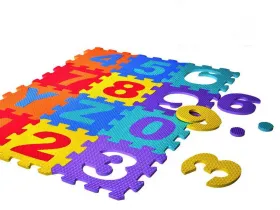
On a purchase order, a multilingual alphabet mat is often described as a single item with two artwork variants. On shelves it behaves as separate products. The script printed on the tile decides which market the set can sit in, which retailer receives it, and whether your promotion sells units or returns pallets. If the seasonal push lands in autumn or at the start of the school year, the decisions that protect it have to be made months earlier, while plate-making, tooling and production time are still on your side. The steps below follow how we run these programs for overseas buyers at our factory, from the first line-art file to the carton label.
Why a language edition is a real product decision, not an artwork detail
With an alphabet mat, the letter set is the function of the product. A Spanish-language set and a Russian-language set share the same tile geometry, the same interlocking edge and often the same colour palette, yet they are aimed at different households and cannot substitute for each other on shelf. A parent buying a Cyrillic set expects the full Russian letter inventory, including characters that do not exist in the Latin alphabet. A buyer of a Spanish set expects the accented vowels and needs to know whether the set treats Ñ as part of the counted alphabet or lists it separately.
This is where promotional planning usually goes wrong. The purchase order describes "36-piece alphabet mat, 2 styles", merchandising assumes both styles sell everywhere, and the language split only surfaces at proof stage — after plates are cut. Treating each script as its own item number from day one keeps quantity, packaging copy and safety documentation aligned with the market that actually receives the goods.
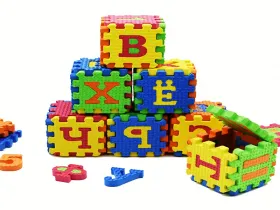
Our multilingual EVA foam alphabet puzzle mats are a working example of how we structure this: two language SKUs, Russian Cyrillic and Spanish Latin, kept as separate item codes on the same tile platform. One tooling investment, two clearly separated market editions.
Step 1: Lock the script inventory before you lock the quantity
Write down exactly which characters each edition must contain, and count them. Do not assume a Latin set carries 26 tiles or that any other script follows the same tally.
- Latin / Spanish: confirm whether accented vowels (á, é, í, ó, ú) appear as extra tiles and how Ñ is counted. That count determines tile quantity per set, not just print layout.
- Cyrillic / Russian: the alphabet runs longer than 26 characters, so a set that mirrors a Latin tile count will be missing letters. Specify the full character list in the file itself, not only in an email.
- Numbers and symbols: state which digits are included and whether any diacritic combinations are needed for the target market's school curriculum.
On our 36-piece interlocking edition, each set carries a complete alphabet plus number inserts in one tile count, with the script fixed per SKU. That is a practical pattern for promotions: keep the piece count identical across language editions so carton quantities, price breaks and shelf facings stay comparable, while the character content changes.
Step 2: Decide how the edition is identified on the product itself
Once two scripts share a tile size and a colour palette, warehouse staff and retailers need a fast way to tell them apart. Pick one primary identifier and apply it consistently across print, packaging and carton markings.
| Identifier | How it works | Best for |
|---|
| Dedicated SKU code per script | Each language edition gets its own item number, carried on the inner packaging and outer carton | Buyers running several market editions in one season; keeps replenishment clean |
| Colour-coded edge or band | The interlocking edge or a printed border differs by edition while tile colours stay shared | Stores where staff restock from open cartons and need a visual check |
| Packaging language block | script name printed prominently on the front panel plus the character list on the back | Online sellers whose listings are matched to the pack photo |
Whichever route you choose, put the identifier on the artwork brief and not only on the purchase order. Our team reviews submitted drawings and samples and returns improvement suggestions on details such as linework before anything is cut, which is the cheapest point to catch an edition mix-up.
Step 3: Match print method to the lettering you need
Small diacritics and thin Cyrillic strokes are the most common casualties of a weak printing process. If the marks fill in or lift, the tile is no longer teaching the correct character.
For letter-heavy surfaces we use self-developed heat-transfer printing on EVA foam, which prints without an underlying base colour showing through and reaches over 95% colour fidelity; multi-pass white-base printing raises saturation further on bright palettes. That matters for multilingual sets because accent marks are small, high-contrast details that a shallow print loses first.
A second decision is whether the characters are printed only or physically part of the tile. Our EVA foam puzzle play mat with removable alphabet and number inserts uses pop-out characters rather than flat print, so children can pull a letter out and build words. For a language edition this adds a real constraint: the insert must carry the correct glyph on both faces, and any character that is part of the interlocking structure cannot be swapped between editions after cutting.
Step 4: Build the seasonal timeline backwards from your delivery date
Language editions multiply approval work, so the calendar has to absorb two proofs instead of one. Here is the sequence we run, with the lead times our factory publishes.
| Stage | What happens | Indicative time |
|---|
| Needs consultation and communication | Target market, script inventory, tile size, piece count, age grading | Days, not weeks — send complete character lists |
| Proposal and quotation | Price per language edition, tooling cost, packaging options | With the quotation |
| Design drafts and renderings | One proof set per script; check every diacritic against your list | Allow a second round for corrections |
| Mould opening and print moulding | Plate-making for the printed artwork | 5–7 days (a five-day plate-making service is offered) |
| Signature confirmation | Signed approval on each language edition before bulk | Your side; sign off the editions separately so a correction on one does not delay the other |
| Bulk production and delivery | Foaming, cutting, stamping, laser processing, printing, inspection | Bulk orders can be delivered within 15 days |
Two practical points from that table. First, plate-making is short but proofs are not: schedule the review of both scripts in parallel rather than one after the other. Second, the deposit on signing the contract is 30%, so confirm the language split before that signature — re-cutting an edition afterwards is a new plate, not an edit.
Seasonal note: for a back-to-school or holiday promotion, work backwards from your in-store or inbound date and add one full proof round per language edition. If urgent orders are involved, our in-house factory can reallocate resources to hold the shipment date, but only if the corrected artwork arrives before production starts.
Step 5: Handle age grading and small-part warnings per edition
Multilingual sets with pop-out inserts carry a small-parts consideration that must appear on every language pack in the language of the destination market. Our multilingual alphabet mats are rated for ages 3 and above, with adult supervision noted for the small inserts. The 26-letter EVA floor mat follows a different pattern: larger interlocking tiles at roughly 30 × 30 × 1 cm, positioned as an early-childhood play mat for children aged 3 and above.
Do not copy one age claim across two product families. Tile size, insert size and piece count drive the warning text, and each market's toy safety requirements are written into the packaging that reaches the consumer. Tell us your destination country and we recommend raw materials meeting the corresponding national standards; our Shenzhen factory holds ISO 9001:2015 certification and CE, EN-71, FDA, FCC, RoHS, SGS and REACH certificates. Ask for the specific certificate or test report that covers your product, market and order before you publish any compliance claim in a listing.
Step 6: Plan one shared platform with separate replenishment
A promotion sells out unevenly across languages. If both editions are one item number, the fast-moving script hides the shortfall and the slow one sits in the same bin. Separate SKUs let you reorder only what moved.
- Order the language split by market, not evenly. Two editions do not imply a 50/50 quantity.
- Keep tile size, thickness and palette identical across editions so replacement packs and mixed displays still look consistent.
- Confirm piece count per edition in writing; a script with more characters changes the insert list even when the set count stays the same.
- For retail programs that need a companion item, our magnetic alphabet puzzle for toddlers uses 26 uppercase foam letters with magnetic backing, which is a Latin-script item and needs its own decision if you want a Cyrillic version.
Step 7: Verify before bulk, then inspect on the line
The last planning task is deciding what you will actually check. Read the proof at tile size rather than on screen, and read it against your character list line by line — accent marks are easy to miss when the layout looks correct.
On our side, products pass through 16 types of testing during production, covering colour fastness, tensile strength, ink material environmental testing and children's product safety testing, followed by full manual inspection before shipment. We support 100% third-party inspection and hold factory audit reports from Coca-Cola, Walmart and Sedex, and we welcome buyer audits.
For a multilingual promotion, add one line to your own inspection sheet: open cartons of both language editions and confirm each set contains the character list you approved. It takes minutes on the floor and it is the only check that catches an edition swapped at packing.
Quick answers
Can we run one tooling set for both language editions?
Yes, when the tile geometry and interlocking edge are shared — that is how our Russian Cyrillic and Spanish Latin editions are structured. The printed artwork still needs a separate plate per script.
When does the language split have to be final?
Before signature confirmation and before the 30% deposit on signing the contract. After plate-making, changing a script means new plates.
Can we add a third script mid-season?
Usually yes as an added edition rather than a change to the existing ones. Send the complete character list early; tile count per set may differ from your first two editions.
Do pop-out inserts cost more than printed letters?
They add a cutting step and a small-parts warning, and they change how the character must be placed on the tile. Ask for a quotation on both structures before committing to one for a promotion.
Send us your script list early. As a
custom EVA foam manufacturing partner with in-house foaming, cutting, stamping and laser processing, we build language editions from your drawings or samples and return review notes before anything is cut. For a seasonal promotion, share the character inventory, tile size and destination country first — plate-making runs in 5–7 days and bulk orders can be delivered within 15 days once approvals are signed. Contact us at
Contact Us or call +86 13827489472 to plan the edition split for your next season.