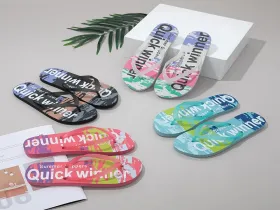
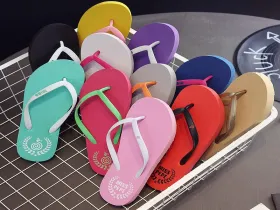
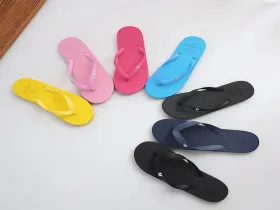
A hollow-cut logo flip-flop looks simple on the beach: light EVA underfoot, a soft strap, and your brand mark cut clean through the sole so sand and water pass straight through the opening. The production file behind it is not simple. One line on a drawing tells the factory where the cutting die lands, and that single measurement decides whether the logo reads clearly from two metres away or collapses into a thin bridge of foam that tears on the first wear.
Most disputes about cutout slippers do not start in the mould shop. They start in the warehouse, when packing staff receive cartons with no note about which side is the display face, and the wrong pair ends up facing customers at a trade stand. Below is the specification pack we ask buyers to send so the die position, the strap, and the carton labelling all agree before a single pair is packed.
1. Fix the logo size and depth before you think about location
Die location only becomes meaningful once the mark itself can survive a cut in foam. Our team reviews every artwork file for three things first:
- Counter space inside letters. Counters are the enclosed holes in characters such as A, O, R and B. In a soft EVA sole, a counter narrower than about 2 mm leaves a thin wall of foam that lifts or breaks during demoulding and handling.
- Strokes and serifs. Hairline strokes under roughly 1.5 mm disappear when the die shears through the sheet, so we redraw them heavier rather than promise an effect the material will not hold.
- Connected lettering. script marks need bridges between letters, otherwise each character becomes a loose piece that falls out of the cut. Where a script wordmark must read as separate strokes, we switch to an embossed logo instead of a hollow one and tell you before tooling begins.
Send the mark as vector artwork with fonts converted to outlines. A JPEG at 300 dpi is not enough for us to measure stroke width reliably, and enlarging a bitmap changes how each stroke will cut.
2. Give die location in real millimetres, not percentages
The most useful warehouse instruction is a dimensioned drawing with three reference dimensions taken from fixed edges of the sole outline:
- Distance from the heel end of the sole to the nearest edge of the logo.
- Distance from the outer side wall of the sole to the nearest point of the logo.
- Rotation angle of the logo baseline relative to the long axis of the sole, in degrees.
Percentages do not work here because a size 7 and a size 11 sole are different lengths. A logo placed at "40% from the heel" shifts by several millimetres between sizes, which is exactly the movement that pushes a mark into the flex zone or under the toe strap. Give absolute millimetre values for each size in your size run, and state whether the logo must sit on the display face — the surface of the sole that faces outward when the pair is worn — or on the underside.
Practical rule we apply on our own tooling: keep every cut edge at least 5 mm away from the sole outline and clear of the strap plug holes. That margin keeps the die from nicking the perimeter and keeps the strap anchor in solid foam.
3. Say which face is up when the pair leaves the carton
This is where warehouse instructions matter most, because a cutout logo can be produced on either face and both look correct in a sample photo. In your purchase order and on the inner label of every carton, state one sentence that cannot be misread:
Display face with hollow-cut logo UP when packed; do not invert pairs at retail display.
We then mirror that instruction through the process: the packing list repeats it, the polybag print carries an up-arrow on the display side, and the pre-shipment inspection sheet includes a check that all pairs in the carton face the same way. If your display fixture shows the underside of the sole instead, tell us early — we move the die to the opposite face before plate-making rather than after.
4. Choose the logo method per part of the shoe
A flip-flop has two brand surfaces and they take decoration differently. Our custom promotional flip flops line covers both:
- Sole: hollow-cut logo, embossed (raised) logo, or heat-transfer printed logo. Hollow and embossed marks need tooling; printed marks need a print plate.
- Strap: screen printing, epoxy coating, or a custom-moulded strap with the mark formed in the material itself.
Our heat-transfer printing is self-developed and prints without an underlying base colour showing through, with multi-pass white-base printing for saturated colours on dark foam. That matters when your artwork has small type that a cut cannot hold — you keep the mark readable by printing it instead of cutting it.
5. What we send back before you approve tooling
Every custom order runs through the same approval chain, and the drawing is signed off at the point where die location is fixed:
- Needs consultation — we read your artwork and flag anything that will not survive a cut.
- Proposal and quotation — including tooling and plate costs separated from unit price.
- Design drafts and renderings — with the logo position dimensioned on the actual sole outline of each size.
- Mould opening and print moulding — only after your signature on that drawing.
- Confirmation of signature, then a 30% deposit on signing the contract.
Plate-making takes 5–7 days and bulk orders can be delivered within 15 days. Because the die is made after your drawing is signed, moving the logo position afterwards means new tooling — which is exactly why we send the dimensioned drawing back to you for checking before it is confirmed.
6. The packing note that protects your promotion
Cutout slippers are usually given away at events, hotel programmes and beach promotions, where the visual effect is the whole point of the spend. Add these lines to your packing specification and we will mirror them on our inspection sheet:
- Which face carries the cut, and which direction that face points in the carton.
- Size break per carton, with the size stamped where staff can see it without opening the polybag.
- Whether spare pairs are mixed into cartons or packed separately for event staff.
Every shipment goes through full manual inspection before dispatch, and we support third-party inspection and buyer factory audits. If your own QC team will check the goods at your warehouse, send them the same dimensioned drawing you sent us — one document, two sides of the transaction, no argument about what was agreed.
Ready to place a cutout-logo order
Fulikai is a Shenzhen EVA foam products manufacturer working from customer drawings and samples, with stamping and laser cutting in our own factory. For branded footwear programmes we also produce custom EVA grass flip flops with perforated logos on the sole, alongside solid-colour and printed beach styles.
Send your artwork as outlined vector files together with the three reference dimensions for each size, and tell us which face is the display face. We will return a dimensioned rendering before any tooling is opened. Call +86 13827489472 or write to sales@fulikaisz.com.cn to start.